7TH BOMB GROUP, USAAF
IN AUSTRALIA DURING WWII
In 1941, the 7th Bombardment Group was stationed at Salt Lake City, Utah. The 7th Bomb Group at that time comprised:-
• Headquarters & Headquarters Squadron
• 9th Bomb Squadron
• 11th Bomb Squadron
• 22nd Bomb Squadron
• 88th Reconnaissance Squadron
Ground Echelon
On 13 November 1941, the Ground Echelon departed Salt Lake City by rail for the Port of Embarkation San
Francisco, with their ultimate destination being “Plum” (code name for the Philippines). The Ground
Echelon sailed from USA for the Philippines on 21 November 1941 onboard the USS
Republic. They arrived in Honolulu on 28 November 1941 and remained overnight
for servicing. The USS Republic was part of the
Pensacola convoy protected by the cruiser USS Pensacola.
18 P-40s, 52 A-24 dive bombers, 500,000 rounds of .50 caliber armour-piercing and tracer ammunition, 9,600 rounds of high explosive for 37-mm antiaircraft guns, 2,000 500-pound bombs, and miscellaneous vehicles and equipment together with 4,600 troops were part of the Pensacola Convoy.
They left Honolulu the next morning (29 November 1941) and crossed the Equator on 6 December 1941. They arrived at Suva, in Fiji on 9 December 1941 after being hastily diverted from their scheduled destination of the Philippines after learning of the surprise Japanese attack on Pearl Harbor on 7 December. The men of the 7th Bomb Group had been called to General Quarters at 1000 hours on 7 December and informed of the Japanese attack on Pearl Harbor.
They left Fiji on 10 December 1941 and picked up two Australian cruisers as escorts 4 days later. They eventually docked at the mouth of the Brisbane River on 22 December 1941. The next morning they repositioned to Hamilton Wharves where they disembarked and marched to Ascot Racecourse where a camp had been hurriedly established.
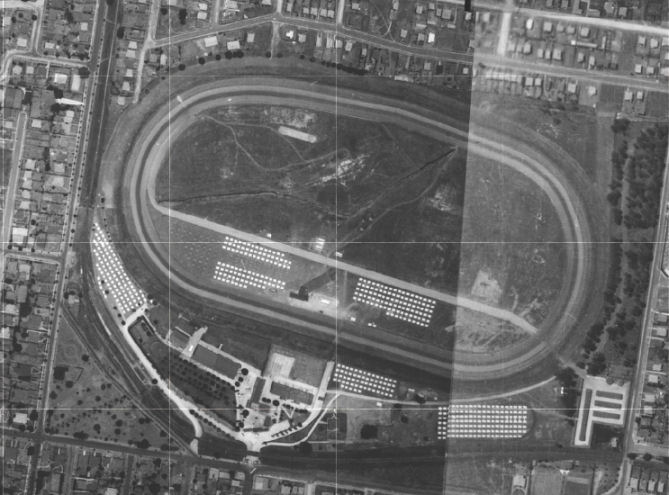
Photo:- via
Soar Atlas
Camp Ascot 20 December 1941
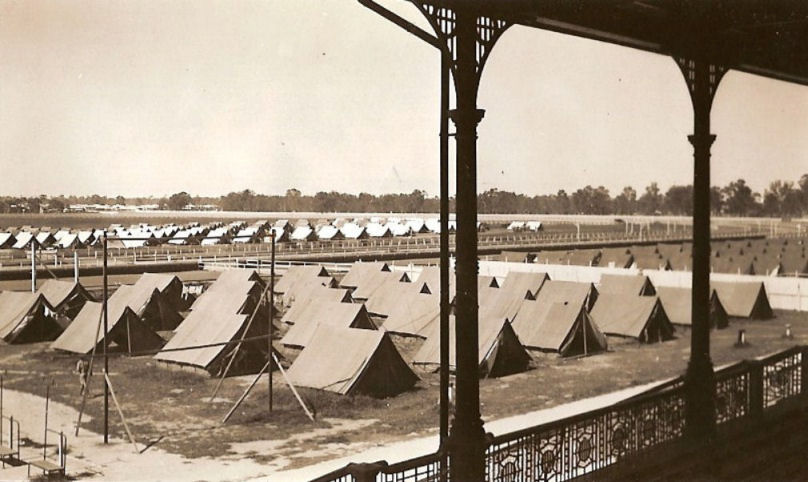
Camp Ascot inside Ascot Racecourse
All of the engineering, armament, and radio technicians of the Ground Echelon of the 7th Bomb Group moved to Amberley Airfield and Archerfield Airfield where they immediately started to assemble P-40 Warhawks and A-24 Dive Bombers. The 9th and 88th Squadrons went to Amberley and the 11th and 22nd Bomb Squadrons went to Archerfield. The remainder of the 7th BG remained at Camp Ascot.
The 8th Materiel Squadron which also arrived in Brisbane on the USS Republic, assisted the 7th Bomb Group with the erection of these aircraft at Amberley Airfield.
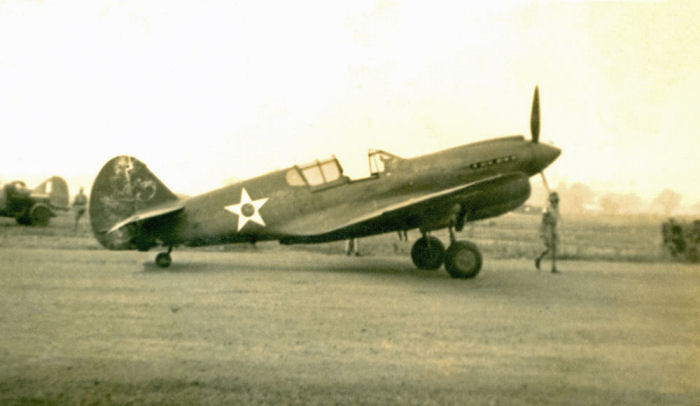
Photo:- Gordon Birkett Collection
P-40E Warhawk at Amberley
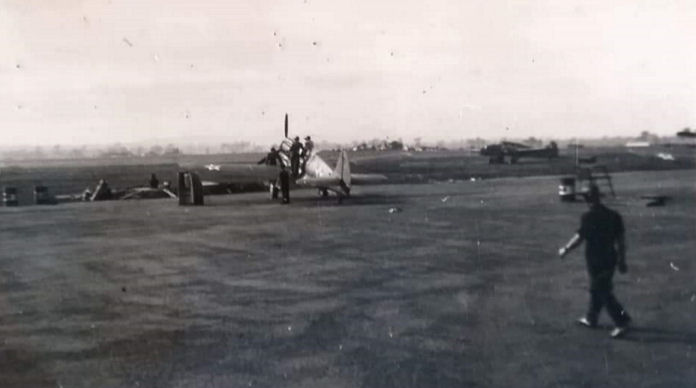
Photo:- Gordon Birkett Collection
One of the Pensacola Convoy P-40E Warhawks at Amberley in January 1942

Photo:- AWM P00264.006
Uncrating P-40E Warhawk AC-5336 of the
49th Fighter Group at Archerfield in early
1942

Photo:- AWM P00264.005
Erecting a P-40E Warhawk at
Archerfield
for the 49th Fighter Group in early 1942

Photo:- AWM P00264.015
Erecting a P-40E Warhawk at
Archerfield
for the 49th Fighter Group in early 1942

Photo:- AWM P00264.001
Erecting a Douglas A-24 Dauntless/Banshee
Dive Bomber #41-15802 at Archerfield Airfield
in early 1942 for the 27th Bombardment Group

Photo:- AWM P00264.002
Erecting a Douglas A-24 Dauntless/Banshee
Dive Bomber #41-15802 at Archerfield Airfield
in early 1942 for the 27th Bombardment Group

Photo:- AWM P00264.003
Erecting a Douglas A-24 Dauntless/Banshee
Dive Bomber #41-15802 at Archerfield Airfield
in early 1942 for the 27th Bombardment Group
The Headquarters and Headquarters Squadron, under Commanding Officer 1st Lt. Henry E. Bolts, was allocated Camp “E” in Camp Ascot for its 22 Officers and 262 Enlisted Men. A Detachment of one Officer and six Enlisted Men from the Hqs & Hqs Squadron was placed on Detached Service to Darwin in the Northern Territory on 4 January 1942.
Major John H. Davies of the 27th Bomb Group reported to Major General Brereton on progress of erection of aircraft on 4 January 1942 as follows:-
Airplanes
(1) P-40's
There are a total of 18 to be assembled. All have been uncrated and 85% of assembly completed. Four have been tested and two ready for test. Lack of Prestone has slowed up the testing of these planes. It is expected that 2 to 3 planes will be turned out each day from now on.
(2) A-24's
There are a total of 32 to be assembled. Fourteen have been tested and three ready for test. Approximately three per day from now on.
On 10 January 1942, one Officer and five Enlisted Men moved from Amberley to Camp Ascot to set up Group Headquarters in the camp area. Captain Nichols, the CO of the 7th Bomb Group, was placed on Special Duty at US Army Headquarters in Brisbane, however he still remained in command of the 7th Bomb Group. The Headquarters and Headquarters Squadron helped to organise the first US Army Headquarters in Australia which was called USAFIA, US Army Forces in Australia. It was based in Lennons Hotel in George Street, Brisbane city.
Between 23 December 1941and 4 February 1942, the Ground Echelon of the 7th Bomb Group assembled 138 P-40 Warhawks, 52 A-24 Dive Bombers, and 5 Douglas C-53 transport aircraft. The assembly of these aircraft was carried out without proper tools and wherever possible the personnel manufactured the required tools. They work shift work to allow the aircraft erection to proceed 24 hours a day. P-40E Warhawk #41-5332 was the first Warhawk flown at Amberley after erection.
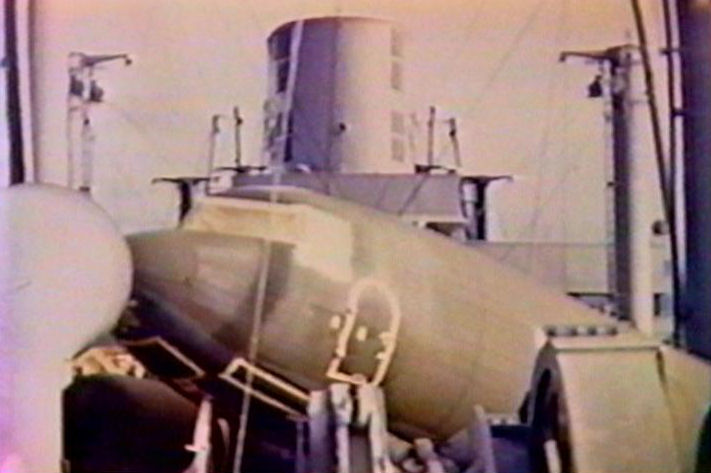
Photo:- Jessie Hague 8mm film collection via Bill Bartsch &
Gordon Birkett
C-53 onboard the SS Polk which arrived in Brisbane on 15 January 1942
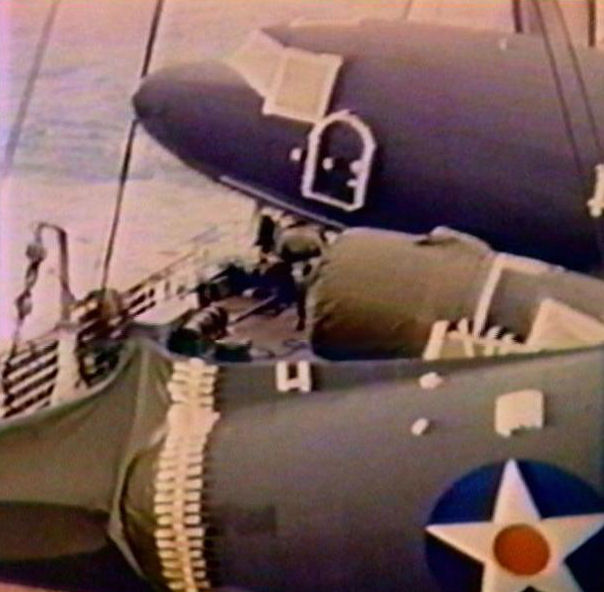
Photo:- Jessie Hague 8mm film collection via Bill Bartsch &
Gordon Birkett
C-53s onboard the SS Polk which arrived in Brisbane on 15 January 1942
The remainder of the ground echelon stayed at Ascot Racecourse and did every kind of work from unloading ships to driving trucks. Guard duty also occupied a great deal of their time. Selected personnel were attached and later transferred to the 27th Bomb Group for the purpose of becoming gunners in their A-24 dive bomber aircraft. These men were trained as A-24 gunners at Archerfield Airfield.
On 19 January 1942, the ground echelons of the 11th and 22nd Bomb Squadrons boarded the USS President Polk and sailed for Java.
1st Lt. James E. Tull assumed command of Hqs & Hqs Squadron from 1st Lt. Henry E. Bolts on 1 February 1942.
From 1 to 3 February 1942, extra details were formed to pack and crate all remaining equipment of the 7th Bomb Group in preparation for sailing to a new secret Station (Java). Remaining personnel at Amberley and Archerfield moved to Ascot Racecourse in preparation for sailing.
An Air-Raid Alert was sounded at midnight on 2 February 1942. All equipment was dispersed as well as possible. Machine Gun Crews were formed from all available personnel not working on the docks and dispatched aboard trucks to vital locations around the Camp area and in the vicinity of the Docks and Warehouses. The All Clear signal was sounded in the early morning hours and personnel proceeded on with their normal duties.
On 4 February 1942, after breakfast, Hq & Hqs Squadron, 9th Bomb Squadron, and 88th Reconnaissance Squadron departed Ascot Racecourse and boarded the USAT Willard A. Holbrook at 1200 hours and sailed for an unknown destination at 2200 hours. This brought to a close the 7th Bomb Group’s involvement in Australia.
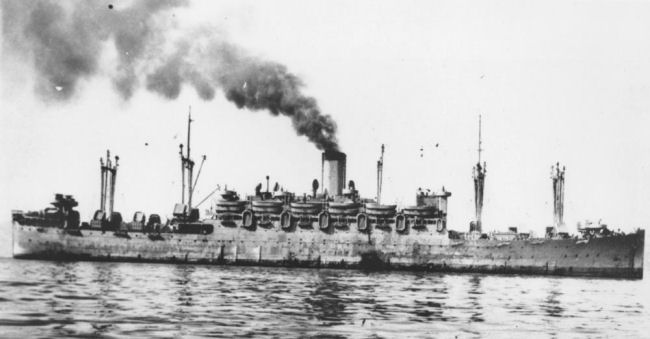
Photo:- Gordon Birkett Collection
USAT Willard A. Holbrook
They sailed down to Melbourne arriving there at Noon on 7 February 1942, where they stayed for a few days. Leave passes were issued to personnel not on duty. Some personnel including Captain Nichols, the acting Group Commander, transferred from the 7th Bomb Group to USAFIA, in Melbourne. 1st Lt. James E. Tull assumed command of the 7th Bomb Group. USAT Willard A. Holbrook was part of Convoy MS-5 which also comprised, British Ships Duntroon and Katoomba, Dutch ship Polyphemus, US Merchant ship Seawitch, which were all to be escorted by USS Phoenix. Seawitch withdrew from Convoy MS05 in Melbourne as it was not loaded.
At 1700 hours on 12 February, the USAT Willard A. Holbrook made its way across the blustery Great Australian Bight and arrived at Fremantle in Western Australia at 1400 hours on 18 February. Leave passes were issued to both Fremantle and Perth during their stay in Fremantle. USS Langley stood in and moored to the dock astern of USS Phoenix on 19 February 1942.
They sailed from Fremantle at 1200 hours on 22 February 1942, again in company with the aircraft carrier USS Langley with USS Phoenix as their escort.
The USS Langley left the convoy on 22 February 1942 and headed for Java. Sea Witch left the convoy on 25 February 1942. USS Langley was sunk by 16 twin engined Japanese bombers and 6 fighter aircraft on 27 February. 36 of the P-40 Warhawks they had erected at Amberley were lost onboard USS Langley. The USAT Willard A. Holbrook was most likely originally headed for Java but with the Japanese invasion of Java on 28 February, the ship was diverted to Colombo. The ground echelons of the 11th and 22nd Bomb Squadrons which arrived in Java in January 1942 on the USS President Polk were evacuated back to Australia in February 1942 when it became obvious that Java would fall to the Japanese.
USS Enterprise took over escort duties from USS Phoenix on 28 February 1942. Convoy MS-5 steered across the Indian Ocean to Colombo in Ceylon, arriving there at 1540 hours on 5 March 1942. They headed to sea again at 1900 hours on 7 March 1942.
They arrived at Karachi at 1600 hours on 12 March 1942. They were the first American Combat Unit to take up station in India. They were billeted in the Dirigible Hangar at Karachi Airport.
|
HEADQUARTERS
7th January 1942
SUBJECT: Commendation TO
: 1st Lt. Paul S. Deems, 9th
Bombardment Squadron (through
1. It is desired to commend you for the extremely capable and efficient way you helped the undersigned organise and administer the Camp at Amberley. The manner in which you performed your duties played a most important part in the successful completion of our primary objective of erecting P-40 aircraft. 2. It is desired that this commendation be placed in your 201 file and attached to your next efficiency report.
s/ Erickson S. Nichols A CERTIFIED TRUE COPY:
EUGENE M. STEVENS, |
|
HEADQUARTERS
7th January 1942
SUBJECT: Commendation TO
: Captain Roscoe T. Nichols, Hq & Hq
Squadron
1. It is desired to commend you for the efficient and capable way you handled the administration and command of the Ground Echelon of the 7th Bombardment Group at Brisbane. Your untiring efforts and resourcefulness, co-operation and efficiency was outstanding and was of the utmost importance in the speedy completion of our primary objective of erecting P-40 aircraft. 2. It is desired that this commendation be placed in your 201 file and attached to your next efficiency report.
s/ Erickson S. Nichols A CERTIFIED TRUE COPY:
EUGENE M. STEVENS, |
|
HEADQUARTERS
7th January 1942
SUBJECT: Commendation TO
: 1st Lt. Benne R/ Leech, 9th
Bombardment Squadron (through
1. It is desired to commend you for the efficient and able way you carried out your duties as mess officer for all American troops stationed at Amberley. Having been appointed to this duty without having any prior experience you showed remarkable energy, resourcefulness and ability. The efficiency with which you established messes for a fed over 1,000 men did a great deal towards furthering to a successful completion of our primary objective of erection P-40 aircraft. 2. It is desired that this commendation be placed in your 201 file and attached to your next efficiency report.
s/ Erickson S. Nichols A CERTIFIED TRUE COPY:
EUGENE M. STEVENS, |
|
27TH BOMBARDMENT GROUP
7th January 1942
SUBJECT: Commendation of 7th Bombardment Group TO : Commanding General, F.E.A.F.
On arrival of the 27th Bombardment Group airplanes in this area the task of assembling them was given the 7th Bombardment Group. The enthusiasm with which they went at the job, the excellent manner in which they surrmounted trying mechanical and armament difficulties and the rapidity in which they completed the assemblying was outstanding. The 27th Bombardment Group is forever indebted to them. It is an organization that makes one proud to call it Air Corps. s/ J.H. Davies 1st Ind. HEADQUARTERS, BASE SECTION, NUMBER
THREE, Brisbane, Q., January 14, 1942:
1. Forwarded: The exemplary conduct and the efficiency in which this organization unloaded, hauled, and assembled a large number of airplanes in addition to handling supply and other functions was so outstanding as to cause favorable comment of Australian observers and the undersigned adds his commendation to the above.
s/ Alexander L.P.
Johnson |
|
UNITED STATES ARMY FORCES IN
AUSTRALIA ------- Melbourne, S.C.1 AG-O. 330.13 HQ UNITED STATES ARMY FORCES IN AUSTRALIA,
Melbourne, Vic., 9 February, 1942. I have noted with much satisfaction the splendid work performed under great difficulty by the Seventh Bombardment Group. It is team play such as this that will bring to our forces the successful accomplishment of the mission assigned. I desire to add my personal commendation to each Officer and man concerned and assure them of my confidence that they will continue to set an example of high standards in future performance of duty.
c/ Julian F. Barnes,
A CERTIFIED TRUE COPY:
EUGENE M. STEVENS, |
The Air Echelon
Information on the Air Echelon of the 7th Bomb Group is very sparse and confusing. There are about 6 historical documents on the 7th Bomb Group in AFHRA Reel No. B00060. Three of those documents only cover the Ground Echelon and the other three have conflicting information on the Air Echelon. These latter three documents appear to be narrative recollections of events some time after WWII.
There is consensus that the Air Echelon of the 7th Bomb Group left Salt Lake City on 5 December 1941 and flew to Hamilton Field, California. Two source states they left Salt Lake City with 35 B-17 Flying Fortresses. The third source said they were to pick up their aircraft at Hamilton Field, though it then went on to say they flew on to Sacramento, then Seattle for new B-17Es.
The 88th Reconnaissance Squadron, commanded by Captain Carmichael took off from Hamilton Airfield on the evening of 6 December 1941 and landed at Honolulu during the surprise Japanese attack on Pearl Harbor. Several aircraft were damaged and some personnel injured. The 88th Reconnaissance Squadron then stayed in Hawaii for some time carrying out patrol duties. At some later date, six B-17E Flying Fortresses from the 88th Reconnaissance Squadron, 7th Bomb Group were assigned to Southern Bomber Command which eventually made its way to Australia together with one B-17 from the 38th Reconnaissance Squadron and five B-17s from the 22nd Bomb Squadron. They went on to become the 435th Bomb Squadron of the 19th Bomb Group based in Townsville, north Queensland.
As mentioned above, one source states that the remaining personnel in the 7th Bomb Group were then all sent to Sacramento, California, temporarily. They then proceeded to Seattle to pick up some new B-17Es. The personnel were then transferred to Bakersfield, California, and patrolled the west Coast of the USA. Very shortly, however, orders were changed, and the entire Group received orders to proceed to wherever the Commanding General of the Far East might be.
The 9th Bomb Squadron led by Captain Necrason was the first Squadron to depart. They followed the route leaving from Tampa, Florida to South America, across Africa and India to Java. The first of these flights left the USA on 28 December 1941 and arrived in Java on 13 January 1942.
The 22nd Bomb Squadron departed across the Pacific to Australia and then to Java. This Squadron at that time was commanded by Major K.B. Hobson. The 9th Bomb Squadron and the 22nd Bomb Squadrons each departed in different directions and each travelling half way around the world landed within one hour of each other at Malang, Java.
The 11th Bomb Squadron commanded by Major A. A. Straubel, picked up LB-30 Liberators at Dayton, Ohio and proceeded to Java. The 9th, 11th and 22nd Bomb Squadrons then took up the task where the 19th Bomb Group had left off. The 7th and 19th Bomb Groups were housed together for some time at Malang, Java, from where many daring and successful bombing missions were carried out against the Japanese. For their heroic defence of Java, the 7th Bomb Group, was awarded one of the first Unit Citations to be given during WWII.
On approximately the 19 January 1942, the 9th and 11th Bomb Squadrons moved to Jokyakarta, Java from where they operated.
When what was left of the 19th Bomb Group returned to the USA after the fall of the Netherlands East Indies, many of the personnel of the 7th Bomb Group were transferred into the 19th Bomb Group and returned home as the 19th Bomb Group. This was always a sore spot with the 7th Bomb Group because the 19th Bomb Group came home to a fanfare of publicity and became internationally known as a Group, while the 7th Bomb Group was transferred from Java to India to continue the war and received virtually no recognition for either their combat or the fact that the 7th Bomb Group men took their glory into the 19th Bomb Group.
Colonel Ralph Royce had been the Commanding Officer of the 7th Bomb Group from 1939 through to 1940. Major Kenneth B. Hobson was the Commanding Officer of the 7th Bomb Group from 4 February to 20 March 1942. Lt. Colonel Cecil E. Combs was then the CO from 22 March to 30 June 1942.
Diary of Wilbur W. Mayhew
88th Reconnaissance Squadron
On 15 January 1941, I was assigned to the 88th Reconnaissance Squadron, which was attached to the 7th Bombardment Group. These units had moved from Hamilton Field, California to Salt Lake City in September 1940. At this time each squadron was allotted eight aircraft. We moved to new barracks at Salt Lake City Airport on 20 January 1941. I was assigned to the photography department of the Squadron at that time. Before we left Salt Lake the photo department photographed and made a mosaic map of most of western Utah and eastern Nevada.
On 31 January 1941, I had my first ever airplane ride. I flew in a B-18A from Salt Lake City to Tucson, Arizona where the 88th Squadron was on maneuvers. I returned to Salt Lake in a B-18 on 18 February 1941.
Near the end of May 1941, we received word that an attempted sabotage was expected at some or all Army Air Corps facilities. Consequently, on 29 May 1941 we were moved to Wendover Field at the border of Nevada and Utah. At that time Wendover Field was simply a dirt runway in the desert with no buildings. We dug "foxholes" for .30 caliber machine guns to protect our aircraft (B-18s and a few early B-17Cs and B-17Ds). I do not know what might have happened if saboteurs had arrived because very few of us had handled machine guns before. We spent the next two miserable days (wind and rain) guarding our planes. Then we returned to Salt Lake City on the afternoon of 31 May. No saboteurs ever showed up at Salt Lake or Wendover. As far as I know, no saboteurs arrived at any of the other air bases either.
In mid 1941 the Army Air Corps became the Army Air Force. At that time heavy bomber groups contained 4 Squadrons, each with 8 bombers, 37 officers and 229 enlisted men.
While we were stationed in Salt Lake, I was sent up in a B-18 to shoot at a target that was towed behind another B-18 over the Great Salt Lake to attempt to qualify as an aerial gunner. I had never seen a .30 caliber machine gun before, let alone know how to shoot one. The gun was mounted in a plastic turret at the back of the plane that had to be cranked up to use. The armourer aboard the plane showed each of us potential gunners where the trigger was and where the safety was, then he got out of the way and let us use the gun. Each of us had our ammunition painted a different color so our shots could be distinguished. I made four flights over Great Salt Lake for gunnery practice. Somehow I hit the target a sufficient number of times to qualify as an expert aerial gunner.
In October 1941, the 7th Bombardment Group and the 88th Reconnaissance Squadron were alerted to prepare for two year's service overseas. The 7th and 88th were scheduled to go to Del Monte Airfield on the island of Mindanao, although at the time all we knew was we were sailing to ''PLUM''. At this time the 7th and 19th Bombardment Groups were the only combat ready heavy bombardment groups in the Army Air Force. (I hate to think what the others were like). These two groups had the majority of B-17s in the Air Force (only 87 in the AAF then). The 19th Group had preceded the 7th to the Philippines.
The ground personnel of the 7th Bombardment Group (Heavy) and the 88th Reconnaissance Squadron left Salt Lake City by troop train at 1:00 P.M. (1300 ) on 13 November 1941 and arrived in San Francisco, California at 10:00 A.M. (1000) on 15 November 1941. The train seemed to stop at every whistlestop between Salt Lake and San Francisco and sometimes even between whistlestops. When we left Salt Lake we were assigned to specific cars with one person assigned to the upper berths and two people to each of the lower berths. As we left the train, we immediately boarded a boat, "El Aquario", and sailed to Fort McDowell on Angel Island in the middle of San Francisco Bay (where I had enlisted 13 months earlier). Those of us that lived within 100 miles of San Francisco were given 24-hour passes so we could go home one last time before going overseas. We remained there until 8:00 P.M. (2000) on 20 November 1941 (Thanksgiving), when we were taken to Pier 7 on the San Francisco waterfront (Embarcadero). There we loaded on the troop transport "USAT Republic" (AP-33 ), headed for the Philippine Islands for two years as part of "PLUM" (Philippine Landing Unit, Manila). We were part of the 2,380 troops aboard (1,098 were 7th and 88th). Other troops aboard included the 147th and 148th Field Artillery of the Texas National Guard (all of whom were later killed or captured in Java). We had to unload 3,000 mattresses before we were allowed to go to bed that night.
The next day (21 November 1941) we sailed at noon and ran into rough seas shortly after sailing under the Golden Gate Bridge. Consequently, most of the troops aboard were seasick before the sun went down. That night lights shone brightly all over the ship. Movies were shown on the after deck. At first all the troops slept below deck. Our location was six decks below the main deck, two decks below the water line. Our compartment contained rows of fold-down bunks, four high. These bunks consisted of a metal frame with canvas stretched across. There was approximately two feet between rows, so space was very restricted. However, during the day the bunks were folded back, so there was a bit more space available then. We slept in our clothes directly on the canvas with no bedding. There really was no place to sit and little room to stand. The light and ventilation were poor. As we approached the tropics, this compartment (and, I assume, all the others) became really hot, humid, and smelly like a gym. Showers, when you could get them, were with salt water. The salt water soap was hard on the skin and very hard to wash off.
The following morning most of us were queasy, if not downright seasick. I managed to be unaffected until we were called to our "abandon ship" stations for practice. We were on the main deck lined up by the ship's rail in our kapok life jackets for what seemed hours. Every few minutes someone would break ranks and lose a meal over the side. Even if one was not seasick already, watching this procedure certainly put one in the mood to become seasick. I managed to hold my meal until I reached the bottom of the stairs to my quarters at the end of the practice. Luckily, there was a bucket beside the stairs.
After the excellent food the men had been given while stationed at Salt Lake, the two meals a day on the "Republic" left much to be desired. For example, the men made bets at breakfast whether the hard boiled egg they were given would be chicken or egg. Frequently, they found young green chickens inside when they opened an egg. The men stood in long lines around the deck to be served meals, then stood at chest high tables to eat. A dining tray had to be held securely with one hand while eating with the other, otherwise the tray would have to be chased down the table as the ship pitched. The smells from the galley usually were overpowering, especially to seasick, or nearly seasick, soldiers. The stink of cabbage being cooked was unforgettable.
With a full load of troops aboard, not everyone could be on deck at the same time. Consequently, people were rotated on deck for a few hours of fresh air. Sleeping on deck also was rotated among the troops. The monotony of nothing to do was one of the hardest things to endure. Card and dice games went on continuously. Some few found places where they could read, when they found any reading material.
The "REPUBLIC" approached the Hawaiian Islands the morning of 28 November 1941. A-20s from bases on Oahu were circling overhead long before we were in sight of land. We were escorted to our dock in Honolulu by these planes. We landed at 10:00 A.M. (1000). The troops aboard the ship were given 4-hour passes to go ashore.
When we reached the streets of Honolulu, we learned that the local Army personnel were participating in war maneuvers. There were machine guns mounted in street intersections behind sand bags and barbed wire, with armed soldiers everywhere we looked. When we sailed out of Honolulu the next day (29 November 1941), we were convinced that no one could surprise the military in the Hawaiian Islands. In fact, in the next few days, we became certain that everyone was ready for war, based on our own experiences (little did we know!!!). Throughout the trip from San Francisco to Honolulu our troopship had been ablaze with lights every night, and movies were shown on deck. However, once we left Hawaii, the ship had a total, and strongly enforced, blackout, even though no war had started yet.
I was rather disappointed in Honolulu itself, but I liked the appearance of the rest of the island of Oahu that I saw. Honolulu has narrow, crowded streets, with about every race on the face of the globe represented in the population. The largest portion at that time, however, seemed to be Oriental---chiefly Japanese. They seemed to be running most of the businesses around there, strangely enough. The Royal Hawaiian and Moana Hotels are really beautiful structures. I would not mind staying there awhile myself. Waikiki Beach was another disappointment. We had much better beaches in Libya. The beach at Waikiki is very narrow, and the swimming area has a coral bottom, which is very hard on the feet. The water is a beautiful shade of blue. The pineapple and sugar cane fields were beautiful sights to see, as one looked back of the city towards the hills.
We sailed from Honolulu at 7:00 A.M. (0700) the next morning (29 November 1941). We sailed due west until we were out of sight of land, then turned southwest. This made no sense to the troops, since Asia was west. We did not know where we were going, but we knew it had to be someplace in Asia. We learned later this route was to bypass the Japanese mandated islands in mid-Pacific as well as deliver two Australian diplomat's bodies to Australia. In a few hours we joined a convoy. The ships in the convoy, besides the ''Republic'', were the light cruiser "Pensacola", a Navy yacht "Niagra", the transports "Meigs", Bloomfontaine", "Chaumont", and the freighters "Admiral Halstead" and "Coast Farmer". We did not know why there was radio silence from our ships after we left Honolulu. However, we could receive radio messages. Another thing we did not expect was the total blackout that was strictly enforced that first night out of Honolulu. This blackout was maintained for the rest of the voyage to Australia (both before and after 7 December 1941).
We had just crossed the equator (6 December 1941 at longitude 165 degrees West) about 1500 miles southwest of Honolulu the day before the attack on Pearl Harbor. The 2380 troops that were crossing the equator for the first time were initiated. This converted all of us on the ship from "pollywogs" to "shellbacks" as members in the "Ancient Order of the Deep" by "King Neptune's Court". With that many to initiate, obviously they could not spend much time on each soldier. Some had their heads shaved, others had to eat shaving cream, etc. Most of us, however, were herded through canvas air tubes that were laid on their sides on the deck. Salt water filled the bottom of the tubes, and sailors with electric "cattle prods" tried to zap us as we went through the tube. Many of us were lucky enough to be missed, but quite frequently a loud yell would be heard, indicating the sailors had been successful with their prods.
REFERENCES
AFHRA Reel No. B00060
ACKNOWLEDGEMENTS
I'd like to thank Gordon Birkett, Bill Bartsch and Karen Nunan for their assistance with this web page.
Can anyone help me with more information?
"Australia @ War" WWII Research Products

|
|
© Peter Dunn 2023 |
Please
e-mail me |

This page first produced 6 February 2026
This page last updated 10 February 2026