39TH TRANSPORT SQUADRON
39TH TROOP CARRIER SQUADRON
317TH TROOP CARRIER GROUP
IN AUSTRALIA DURING WWII
The 39th Transport Squadron was constituted on 2 February 1942 and activated on 1 June 1942 assigned to the 317th Transport Group.
On 19 June 1942, the 39th Transport Squadron with no personnel assigned, departed for Bowman Field, Louisville, Kentucky along with Group Headquarters, the 40th, 41st, and 46th Transport Squadrons of the 317th Group. The first morning report of the new Squadron was dated 24 June 1942. Pilot training at Bowman Field consisted of many short cross country navigation flights, both day and night.
Captain W. A. Williams, Headquarters and Headquarters Squadron, 317th Transport Group, was attached to the 39th Troop Carrier Squadron and assumed command on 24 June 1942. The command changed on 26 June 1942, when 2nd Lieutenant Joseph C. Ford III joined from Group Headquarters. He was to lead the 39th Troop Carrier Squadron until his death in an aircraft crash at Finschhafen, New Guinea on 8 May 1944.
The Squadron was activated under Table of Organisation and Equipment Number 1-327, dated 1 July 1942, which authorised a total enlisted strength of 288 Air Corps personnel, plus 11 Arms and Services composed of two Chemical and nine Medical personnel, or a total of 299 enlisted men. Authorised strength of officers was 45 commissioned, plus one Warrant Officer, Air Corps. Medical officers added two to the total.
The Squadron was redesignated the 39th Troop Carrier Squadron on 4 July 1942 and assigned to the 317th Transport Group stationed at Duncan Field, San Antonio, Texas by authority recorded in General Orders No.14, Headquarters, Air Transport Command.
The Squadron was on alert for overseas shipment in December 1942. The Squadron was located at Lawson Field, Fort Benning, Georgia from 9 October to 7 November 1942. At Lawson Filed, the Squadron had a month of good flying and excellent training, particularly in dropping paratroops. On weekends, some of the aircraft were allowed to go on long cross country flights.
They were located at Laurinburg-Maxton Field, North Carolina from 7 November to 12 December 1942 for glider training. The ground echelon was ordered to Camp Stoneman, California on 13 December 1942 for preparation for movement overseas. The ground echelon boarded SS Maui on 29 December 1942 at San Francisco. The SS Maui set sail for Australia on 31 December 1942. The SS Maui docked in Townsville on 23 January 1943 where the ground echelon disembarked and moved to Garbutt Airfield. They were joined by part of the air echelon. The 317th Group Headquarters, the 40th TCS, 41st TCS and 46th TCS which all accompanied the 39th TCS on SS Maui were assigned to Garbutt Airfield for a permanent change of station while the 39th TCS was directed to proceed to Brisbane. The 39th TCS reboarded the SS Maui at Townsville and two days later arrived in Brisbane on 3 February 1943.
While the ground echelon was stationed at Camp Stoneman, the air echelon was stationed at Sacramento Airfield, California for three weeks. From Sacramento, the air echelon proceeded to Hamilton Field, where the first pilots were given hurried instrument checks and instrument cards. After a long ten hour shakedown flight to Tucson and back, the Squadron was ready for the flight over the Pacific
The 39th Troop Carrier Squadron moved to Camp Muckley about 1 mile from Archerfield Airfield under the control of the 11th Replacement Control Depot. New barracks were built for the 39th Troop Carrier Squadron at Archerfield Airfield beside Beatty Road as seen in the photo below. The 39th Troop Carrier Squadron moved to their new barracks at Archerfield Airfield on 22 February 1943 using RAAF-built steel roofed barracks formerly occupied by the 21st Troop Carrier Squadron. Hangars and offices were assigned to various departments. Their single office building housed the Orderly Room, Operations and Intelligence Departments as well as the Commanding Officer and Adjutant, which resulted in considerable crowding. There was no pilot ready room, and pilots generally dropped into the Intelligence Office to discuss the war, flying, weather and other subjects. A practice that was encouraged by the Intelligence Officer.
The Squadron personnel were quartered in sixteen buildings, the enlisted men having the open barracks and the officers the partitioned ones. One building was set aside for an officers' day room and Post Exchange, another for the enlisted men's day room, with two others for mess hall and kitchen. A fifth was a shower and wash room and the other doubled as motor pool office and barracks for personnel of the transportation department. To some degree, personnel were quartered according to departments.
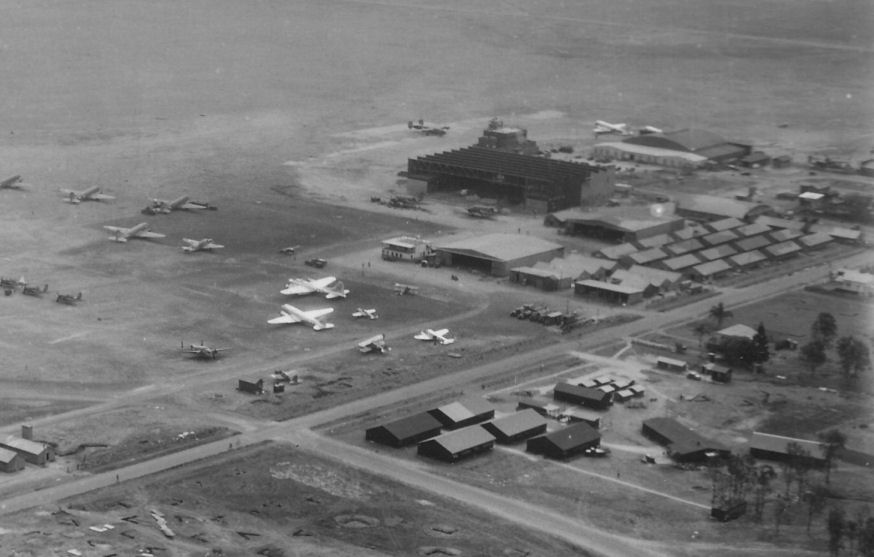
The new barracks for the 39th Troop Carrier Squadron can be seen at the right centre
Transportation was set up to provide vehicles for regularly scheduled runs to Brisbane. Officers and enlisted men were carried back and forth for purposes of recreation, the last bus leaving downtown Brisbane at 1:00 A.M. Since commercial transportation facilities were overtaxed, the Squadron service proved to be a boon. Personnel were quick in establishing congenial social contacts in town. Relations between the members of the Squadron and Australians were excellent. At all times the behaviour of the men was such as to reflect credit on the entire Squadron. No serious infractions of proper conduct were ever charged against members of the unit, and as a consequence, the 39th received more than its share of invitations to social functions.
Due to the close proximity of Brisbane and the many diversions available there, organised activities within the Squadron did not find strong support. However, a basketball team was organised and participated in the Base Section Three League, wining six games out of the ten played.
At the request of Major Ford, Squadron Commander, two nearby houses were made available by Base Operations - one for use by officers, the other by enlisted men. Both were in need of repair and extensive work was begun. Lights were installed, furnishings purchased or made by the men, and bars built and decorated. Rooms were set aside for cards, reading and refreshments. Sets of rules were drawn up governing the behaviour of club members and inflicting penalties for infractions. Both clubs were organised on much the same plan with a president, vice-president, secretary and treasurer. Committees were appointed to handle special functions and obtain supplies. Liquor was drawn on the Australian canteen, the basis for the officers' club being the number of members, and for enlisted men, the number of sergeants. Consumption of liquor was restricted by the policy of drawing only on the basis of the number of Sergeants, although enlisted men were eligible to become members irregardless of grade. No one was permitted to buy bottled liquor for removal from the non-com's club premises, unless it was to be carried from the field area for use on furlough. The club was strongly supported and the dues of ten shillings per month established a fund for improvements and salaries for help employed.
In commemoration of the Squadron's first anniversary, a party was given and attended by officers and enlisted men. A chicken dinner complete with wine and all trimmings preceded the party in the Squadron area. After dinner, buses carried the men to Brisbane where the ballroom of the Bellevue Hotel had been engaged for the evening. Jack Fischer and his 32nd Division Orchestra furnished the music, the Red Cross furnishing the extra girls. No liquor was served at the dance but refreshments were supplied by the Squadron. Major Ford, following his custom, gave a speech at the enlisted men's dinner at which he was a guest. He spoke of the Squadron's achievements since activation and of the excellent record established overseas, of the esteem in which the men were held by higher commands and expressed a hope for continued success.
Every Saturday night a dance was held at Evans Deakin of Moorooka and St. Bernard's Church on Thursday nights. Between the club, field movies, dances and the attractions of Brisbane, there was no lack of entertainment for the men of the 39th Troop Carrier Squadron.
In the early hours of 3 January 1943, six C-47s of the 39th Troop Carrier Squadron took off from Hamilton Field for Australia via Hickham Field, Hawaii. It was the first squadron of the 317th Troop Carrier Group to leave the United States. The 40th TCS left the following day, then the 41st TCS the next night and finally the 46th TCS three days later. They flew via Christmas Island, Canton Island, New Caledonia and arrived at Amberley Airfield in south east Queensland, Australia. On 5 January 1943, another six C-47s took off from Hamilton Field to follow the same route to Australia. The thirteenth aircraft was held at Hamilton Field due to engine trouble and flew to Australia some 30 days later on 4 February 1943. The Air echelon rejoined the Squadron at Archerfield. On arrival in Australia, the squadron was placed on temporary duty with the 374th TCG in Port Moresby. Earlier in late December 1942, 21 NEI-AF aircrew had been designated a separate “transport unit” and was seconded to the 5th Air Force. When the 39th TCS arrived at Archerfield Airfield, the NEI-AF “transport unit” was attached as a separate flight to the 39th TCS. The Dutch crews were more experienced than the newly arrived American air crews. From September 1943, the Dutch crews also severed with the 21st TCS.
They were to remain at Archerfield for the following 8 months. Whilst at Archerfield, Squadron aircraft afforded transportation to key military figures including Generals Whitehead and Eichelberger and comedian Joe E. Brown. From Port Moresby, during the latter part of 1943, Squadron aircraft carried Ray Bolger, Cary Cooper, Phyllis Brooks and Una Merkel.
Special Orders No. 56, Headquarters Fifth Air Force, APO 925 dated 25 February 1943 transferred 39 Glider Pilots and 34 Glider Mechanics from the 11th AC Replacement Control Depot at Camp Muckley to the 39th Troop Carrier Squadron. The Squadron trained on CG-4 gliders while they were at Archerfield Airfield although gliders were never later used in combat in New Guinea. Gliders arrived in crates at Eagle Farm airfield and were transferred to Archerfield Airfield and assembled. They were test flown towed by C-47s from Archerfield to Amberley and return. A few were also towed to Townsville. Two American airmen who flew in the gliders and were stationed at Archerfield were Sgt. Earl Mahan and Sgt. Bob Nelson. Sgt Earl Mahan settled in Brisbane after WWII.
There were various short periods of detached service when a special operational assignment was required, and a part of the air echelon was stationed away from Archerfield. One of these assignments involved the flying of a courier aircraft in New Guinea. Another required the placing of one crew on Detached Service for 40 days, flying from Darwin to Adelaide.
A mission to Fenton Airfield in the Darwin area, for the purpose of carrying mines and detonators nearly resulted in the loss of one aircraft. Departing from Archerfield at 0520 hours on 29 June 1943, C-47A VH-CGF, with F/O J. B. Dozier as pilot, and F/O B. Morehead as co-pilot, with S/Sgt P. Austin as crew chief and Cpl. C. H. Flath as radio operator, arrived at Fenton Airfield after stopovers at 1225 hours on 30 June 1943. While the aircraft was wiring for passengers to take-off again, a “yellow” alert was sounded, followed shortly by a “red” straffing alert. The crew and passengers took cover against the trees, in culverts and in trenches. Anti-aircraft guns were soon heard as aircraft approached from the Darwin direction. When the Japanese were overhead , there were 21 silver-coloured twin-engined aircraft flying in a V of Vs with one aircraft lagging behind.
Between 80 to 100 bombs were dropped on the area, consisting of incendiaries, demolition and anti-personnel types. Three B-24s. one Curtiss trainer, a fuel truck, the engineering and sheet metal shops were all demolished. One of the B-24s parked in the dispersal area only 30 feet from a new C-47 of the 46th Troop Carrier Squadron, was aflame with its ammunition and missiles flying off in all directions. The C-47 itself was damaged and fuel was running from a hole in the wing.
In spite of the danger from the exploding ammunition in the B-24, and the possibility, of the leaking fuel being ignited in the C-47, F/O Barker Morehead entered the C-47, started the engines and taxied the aircraft to safety. The squadron ship, VH-CGF, was carefully examined for damage after the raid was over, but none was noted at the time. However, when taxing to the runway, a hole was observed in the wing surface, just in front of the fuel tank. Careful examination disclosed that whatever foreign object had made the hole must still be imbedded in the wing, since there was no hole to indicate that the object had made an exit. Cowlings were removed but the object could not be found, and it was judged safe to proceed on the flight. A take-off was made and the trip completed to Brisbane without incident. Upon arrival in Brisbane, sheet metal men removed an unexploded Japanese incendiary bomb from the wing about three inches long and one inch in diameter.
An unusual mission on 21 July 1943 consisted of a Squadron of C-47s escorting a flight of P-47 Thunderbolts, then new in the SWPA theatre, to the fighter base at Port Moresby. Three of the P-47s cracked up in Townsville, and later at Horn Island, the pilots and crews were introduced to mosquitoes, bully beef, and sleeping on the ground.
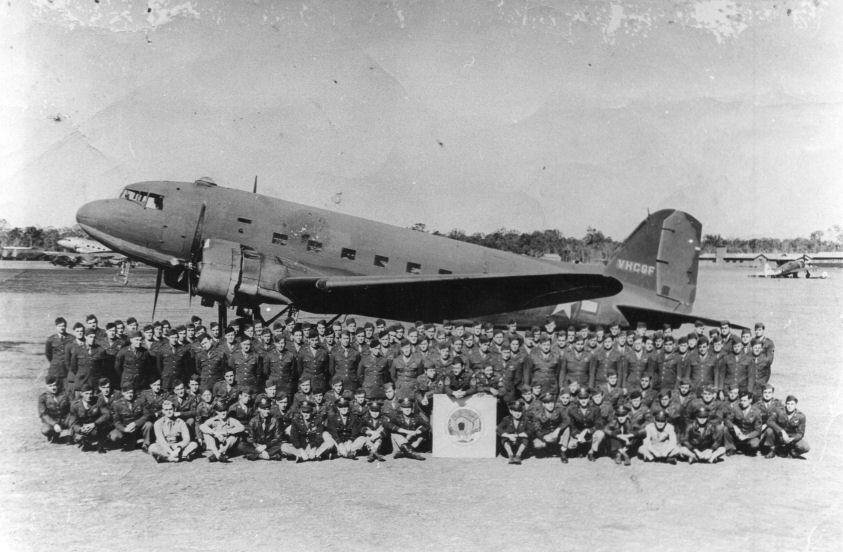
39th Troop Carrier Squadron at Archerfield Airfield in about August 1943
In late August 1943, a B-24 Liberator was stranded on the salt flats, 28 miles from Drysdale Mission in the Darwin area. The tide would rise in ten days and flood the area, thus rendering the B-24 useless. In a race against time, a 39th TCS C-47 piloted by F/O P. J. Rawlings, with Lt. P. Hunsacher as co-pilot, S/Sgt A. W. Hoffman as crew chief, and Cpl. R. Hoffman as radio operator, was loaded with the necessary equipment to place the bomber back in commission and dispatched to the location. Led by a Curtiss Falcon flown by a service squadron pilot, the C-47 came in for a landing at the slowest possible speed. The surface of the salt flats consisted of about 1 ¼ inches of crystallised salt with a mixture of sand. As the wheels of the aircraft made contact with the salt crust, the left wheel broke through and started to sink to the hub. In order to keep the aircraft from ground looping to the left, the right brake was applied, causing the right wheel also to sink through the crust. Continuing his resourceful handling of the aircraft, the pilot pulled back the control stick and gunned the engines with full power, thus preventing the aircraft from nosing over. The aircraft, then in balance, drove forward, plowing a furrow hub deep which slackened the abruptness of the stop.
The B-24, with hours of work ahead, had been saved, but the problem was presented of how to maneuver the C-47 into position for a take-off. Fortunately, about 24 aborigines had been attracted by the landing of the aircraft, and two of them spoke pidgin English. The aborigines were wired with the promise of chewing tobacco as pay. They cut down small trees with amazing speed, binding them into mats which were placed about the left wheel. Applying the right wheel brake, the aircraft was swung around so that the left wheel came to rest on the matting. The same procedure was followed with the right wheel. Logs were placed behind the wheels, and with the aid of a rope and the strong backs of the aborigines, the aircraft was pulled backwards to firmer ground about 100 yards away. Another tow of 250 yards brought the plane to a position for take-off. Using half flaps and full power, the aircraft literally leaped off the salt flats in a distance of about 350 feet. Once in the air, the radio operator relayed a message to a service depot requesting that all necessary materials for a complete runway be dropped from a cargo plane or landed by barge in order that the B-24 might take off after repairs were completed.
The basic mission of the 39th Troop Carrier Squadron consisted of carrying personnel and freight to many points on the Australian mainland and New Guinea. Key military personnel, visiting celebrities, troops on leave, wounded and other casualties were provided with air transportation between the islands and the mainland. In addition, transport aircraft of other units stationed at Archerfield, and transient squadrons passing through, were serviced by squadron engineering personnel. Cargo carried included almost every type of military equipment from guns to trucks. Whatever was of proper weight and bulk for shipment by air was at one time or another carried in Troop Carrier aircraft.
The time soon came when Brisbane became only a pleasant memory. Late in September 1944, the unit moved to Port Moresby, New Guinea. While there were regrets at leaving good friends, many of the men were glad to move closer to the combat zone. The Squadron occupied the area vacated by the 21st Troop Carrier Squadron. Tents were in need of salvage and the area was in a generally unkempt condition. The men went to work and during the course of their stay transformed the area into an attractive camp site, with floors in many of the tents and other conveniences.
Line departments were assigned to an area at the south end of Ward's Strip, about a mile away from the main area. Water became a serious problem as the military population of Port Moresby overtaxed the available supply lines. On many days the water was turned off altogether. It was necessary to build storage tanks and haul water by truck.
A native-built thatched roof hut was set aside as a non-coms club, and work commenced in making it livable. A cement floor was laid, a Post Exchange built, and a bar for serving refreshments at parties. A Coca-Cola machine, purchased in Brisbane, was installed - one of the few to be found in the Port Moresby area. After the club was complete with furnishings and decorations supervised by Lieutenant Nehring, an opening party was held on 1 February 1944 with Red Cross hostesses as a leading attraction.
Squadron Special Services maintained a library of books and magazines, provided ping-pong tables and other games. While not on the army special service distribution for movies, a projector was secured and films obtained from Group Headquarters after a regular showing there. A late movie then followed at the Squadron area. Trips were organized to native villages, scenic places, and fishing expeditions were arranged with the cooperation of the Red Cross.
Pride in the organisation grew stronger as the months went by, until the men all sincerely felt that their outfit was unsurpassed in the Troop Carrier units of all the Army Air Forces. The Squadron had led the group, and the group had been commended for performance it would be "difficult to surpass or even equal." Awards of medals gave the men a sense of having a vital part in the total effort. An Esprit de Corps characterised every aspect of the Squadron's activities. The men on the line took personal pride in bettering their outstanding "in commission" record. This spirit was born in the days at Bowman, Lawson and Maxton - grew to maturity at Archerfield, and continued to flourish during the days in New Guinea.
After eight months at Archerfield Airfield the 39th Troop Carrier Squadron relocated to Port Moresby, in New Guinea on 28 September 1943. The 21st Troop Carrier Squadron was then in the process of moving from Port Moresby to Archerfield. An exchange plan was agreed to whereby each unit left all but personal equipment for the other unit.
The squadron’s emblem which consisted of a flying wagon train was created on 27 October 1942.
LATER MOVES
The 39th Troop Carrier Squadron was later posted to the following locations
during WWII:-
| 23 Apr 1944 | Finschhafen, New Guinea |
| Jul 1944 | Hollandia, New Guinea |
| 19 Nov 1944 | Leyte, Philippines |
| 28 Mar 1945 | Clark Field, Luzon, Philippines |
| 19 Aug 1945 | Okinawa, Japan |
AIRCRAFT INCIDENTS
There were five aircraft incidents during the period Jan 1943 through to January
1944:-
1. On approximately 1 February 1943, C-39 VH-CCG,
forced landed at Dalby due to bad weather. Damage was repairable.
2. On 25 March 1943, C-60 VH-CEG, at Wards Drome crashed on landing due to pilot
error caused by landing downwind. The aircraft as salvaged for parts.
3. On 28 October 1943, C-47 #42-25384 ran into a six foot ditch on landing at
Gusap, New Guinea. It was salvaged for parts.
4. On 13 November 1943, C-47 #42-23581 (No. 7) hit a ditch whilst landing at
Gusap, New Guinea. It was salvaged for parts.
5. On 17 November 1943, C-47 #42-23959 (No. 15) hit a ditch on landing at
Nadzab, New Guinea when its right tyre went flat. The damage was repairable.
There were a number of minor accidents, such as damaged wing tips resulting from collisions with trees and other obstacle whilst taxying.
TROOP TRANSPORT
by S/Sgt. Paul F. Maujean
39th Troop Carrier Squadron.
SOARING O'ER THE TREE TOPS HIGH
WATCHING THE CLOUDS GO DRIFTING BY
MY EYES ARE ROVING NEVER STILL
LOOKING WESTWARD, O'ER THE HILL.
DOWN THROUGH THE VALLEY AND UP THE PASS
SAILING ALONG, EVER SO FAST
LOOKING FOR DANGER, LURKING NEAR
WATCHING THE FRONT, WATCHING THE REAR.
DURING THIS HOUR WHEN NERVES ARE TENSE
I SEE YOUR FACE THOUGH CLOUDS ARE DENSE,
NEVER FAR FROM MY THOUGHTS, YOU'LL BE
CLOSE TO MY SIDE, FLYING WITH ME.
ENOUGH OF THIS DREAMING AND BE ALERT
MANY ARE DYING, MANY ARE HURT
WAITING FOR SOUNDS OF YOUR ENGINES ROAR
BRING YOU NEARER, NEARER ONCE MORE.
THOUGH OUR PLANE IS STURDY, PROTECTION THERE'S
NONE
NO ARMOUR, NO BULLETS, NOT EVEN A GUN
THOUGH OUR HEARTS ARE STRONG AND FACES ARE GRAVE
WE REMEMBER THE MEN WHO ARE JUST AS BRAVE.
SO THROUGH ALL KINDS OF HELL, ALL KINDS OF
WEATHER
YOU'LL FIND US AS ONE, STICKING TOGETHER
NEVER A WORRY OR NEVER A CARE
OUR DUTY IS ONE, BE SURE TO GET THERE.
WE GATHER NO GLORY, OUR NAMES ARE UNKNOWN
BUT TOGETHER WE FLY, TOGETHER WE'VE WON
WE ARE JUST MEN AND GOD GAVE US BREATH
TO LIVE, TO FIGHT, TO THE END, MAYBE DEATH.
BUT NO MATTER WHO CARES, WHETHER WE'RE SAFE OR
LOST,
THE BATTLE IS WON, REGARDLESS OF COST.
SOMEDAY WE'LL LOOK BACK ON THE THRILLS AND THE CHILLS
ONCE MORE WE ARE SOARING UP OVER THE HILL.
CLOSE TO THE WATER, CLOSE TO THE GROUND
WHEREVER THERE'S TROUBLE THE TRANSPORT IS FOUND
CARRYING THE WOUNDED, FEEDING THE MASS
OUR WORK IS OUR GLORY AS LONG AS IT LASTS.
REFERENCES
39th Troop Carrier Squadron - Pacific Wrecks
Can anyone help me with more information?
"Australia @ War" WWII Research Products

|
|
© Peter Dunn 2023 |
Please
e-mail me |

This page first produced 29 April 2026
This page last updated 29 April 2026