FRASER COMMANDO
SCHOOL
FRASER ISLAND, QLD
DURING WW2
Fraser
Commando School was the principal basic-training establishment
of
the Services Reconnaissance Department (SRD). It opened in
October 1943 on
Fraser Island, Queensland, and operated until September 1945.
ISD
personnel had previously been trained at the Guerrilla Warfare
School at Foster, but the southern Victorian climate caused
sickness among
operatives who were more accustomed to tropical environments. Z
Experimental
Station at Cairns subsequently became a training establishment,
but security
and logistical circumstances eventually made a dedicated Fraser
Island school
desirable.
The
Fraser Commando School’s existence resulted from a fundamental
SRD
problem: ordinary military training did not adequately prepare
personnel for
clandestine missions, intelligence parties and small-party
operations in
enemy-held territory. SRD therefore created specialised training
establishments
in which personnel learned insertion and infiltration,
communications using
special equipment, jungle living, working with indigenous
populations,
operating in small-parties, intelligence, languages, small
boats, signals and
other specialised skills. FCS became the principal basic school
within that
system.
The
school was deliberately situated in an isolated environment
where
jungle and boat training could be conducted close together and
with limited
civilian contact. The island's isolation was simultaneously its
principal
security advantage and its greatest logistical disadvantage.
The
initial camp was largely tent-based. By 1944, the weather was
damaging the marquees, so permanent/prefabricated structures
were progressively
introduced.
During
July–September 1944 the following were erected:-
Additional structures included:-
The expanding food requirement also required another cool
chamber and
butcher shop.
The
camp initially had very few amenities. A dry canteen was
established
soon after arrival.
A recreation hut was built in July 1944 with:-
Films became an important part of camp life. A 16-mm projector
was
obtained and training films were shown. In April 1944
arrangements were made
for American entertainment films, with programmes shown three
nights a week.
A library began with books from the Maryborough School of Arts
in
November 1943 and eventually grew to approximately 400 volumes.
By the end of its existence, 909 students, including 142
Filipinos, had
passed through FCS, while 76 instructors served there. The
school therefore
constituted a substantial training establishment rather than a
small specialist
camp.
The various Camp locations associated with FCS were as follows:-
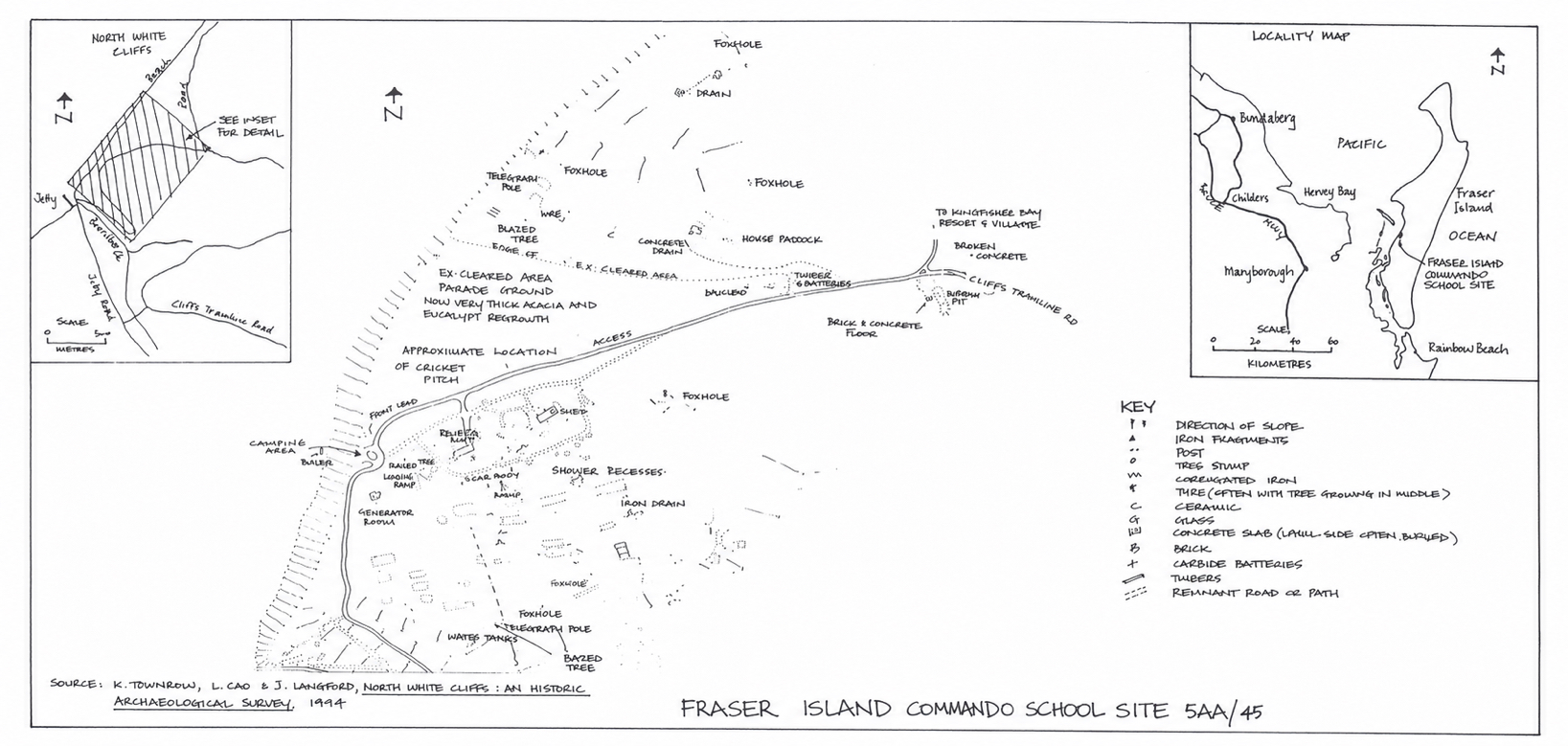
FCS Main Camp
Fraser Island (see sketch below)
Malay
Camp
2 miles south of FCS Main Camp – Dec
1943
Lake
Camp
Lake McKenzie, 5 miles from FCS Main
Camp
Filipino
Camp
A few hundred yards north of FCS
Main Camp
Urangan
Depot
Opposite Urangan Jetty,
stores/supply/administration
Staging
Camp, Urangan
Established
Feb 1944, approx 2 miles south of original Urangan Depot, near
Gravel Jetty
The
SRD training establishments included:-
So FCS could not be regarded as providing the entirety of SRD
training
for operatives. The training system comprised three broad
stages:-
Basic training → specialist
training →
pre-operational training.
The Training Directorate later formalised this structure. FCS
provided
the normal basic course, while specialist and final party
training occurred
elsewhere. Certain specialist subjects—including demolitions,
beach landings
and signals—were nevertheless conducted at FCS.
Fraser island was chosen because it was isolated from the
mainland and,
apart from a small Forestry Section, was effectively uninhabited
for SRD's
purposes. The island also provided adequate opportunities for
jungle training
and boat training.
Whilst its seclusion was its principal advantage, it also
presented some
significant disadvantages; its location created serious
logistical issues for
the operation of the training school as follows:-
Security and training value were therefore prioritised over
administrative convenience.
An advance party arrived on 6 October 1943 consisting of:-
together with a detachment from 9 Army Troop Company, RAE,
consisting of
Lt. J. Gray and 16 other ranks. Lt G.H. Greaves arrived with 18
Timorese on 7
October 1943.
Lt S. Coleman and another 35 other ranks arrived on 8 October
1943.
The engineers installed:-
The
Timorese group under Lt. Greaves constructed the road from the
beach
to the camp.
The road required clearing and levelling and was surfaced with
corduroy.
This work took approximately three weeks.
Initially, stores were hauled manually from the beach up a sand
cliff
because neither motor nor horse transport had yet arrived on
Fraser Island.
FCS required an unusually elaborate water-transport system. FCS
received:-
A particularly important vessel was "Marina" (AM 188), which
arrived in March 1944 and was placed on the Urangan – FCS ration
run.
Because Urangan's Gravel Jetty was inaccessible at low tide and
weather
frequently caused delays, the ration route was shifted to
emanate from
Maryborough instead of Urangan. Although this was a longer water
journey the
new arrangement proved more reliable.
Two 44-foot ALCMs were eventually allocated to the school. A
38-foot
barge was also operated. A bondwood launch was used for
personnel and
special/emergency movements. Several dinghies were used to move
people and
stores between larger craft and the beach.
The lugger “Charm” arrived at FCS in January 1944. Its purpose
was
training:-
At the same time H.M.A.S. Alatna was stationed at FCS from
February to
April 1944 for para-naval training. Thus maritime training
ranged from small
craft and folboats through to more advanced naval cooperation.
FCS also maintained horses. Eight horses arrived in November
1943:-
A further nine arrived in March 1944:
Lt G.H. Greaves controlled horse transport and supervised:
FCS initially had almost no motor transport. The first jeep
arrived at
the end of October 1943. A second arrived shortly afterwards.
Repeated requests
eventually produced a fleet of six jeeps with trailers.
Major repairs could not be undertaken on the island and vehicles
requiring major attention had to be sent to Urangan, where 240
Aust Light Aid Detachment
arrived in September 1944 and supported FCS. Again, this shows
the logistical
cost of choosing isolation.
Training for 100 students commenced at FCS in
November 1943.
Phase 1 comprised a five-week preliminary
phase.
In Phase 2 training Students were formed into
operational parties and given training appropriate to their
specific target.
In December 1943, Flight Lieutenant Cook and Captain Carey
conducted
experiments at Darwin to adapt B-24 Liberators for parachute
During January 1944:-
The wider SRD parachute training system also used the Army
Parachute
Training Unit at Richmond. By July 1945 the SRD Training
Directorate reported:-
The main objectives of FCS training were as follows:-
FCS reached a high standard in weapons and demolitions training.
Signals were treated as both a specialist skill and a minimum
competency
for ordinary operatives.
The principal objectives with intelligence training included
giving
students an intelligence background, particularly in:-
FCS therefore provided an intelligence foundation, although the
wider
SRD training system contained other establishments dedicated
more specifically
to intelligence and clandestine methods.
After feedback from the field, there was an increased emphasis
on Malay
instruction.
The isolated nature of FCS made a resident medical officer
necessary,
while operational parties needed instruction in:-
Instructors at FCS were as follows:-
FCS did not merely record whether a student completed the
course. Each
student was graded as follows:-
A — Party leader, outstanding
B — Very good; suitable as
party
second-in-command
C — Good operative
D — Needs further training
E — Rejectable
A special addition was made to the camp in March 1944 to
accommodate
Filipino students undergoing special SRD training. A permanent
camp staff of 12
Filipinos was provided by AIB.
They arrived with 45 students on 17 April 1944.
After
that course, another 60 Filipinos arrived and nearly completed
basic training before being withdrawn, apparently because of
impending
operations in the Philippines. The Filipino camp was
subsequently dismantled.
FCS records show that there were 142 Filipinos among the total
909
students that attended FCS.
The training at FCS was inherently dangerous, involving:-
Nevertheless, the FCS record says there was only one serious
training
accident during nearly two years. During the first week of July
1944, Sgt Lofts
suffered an accidentally self-inflicted head wound on the range
and died two
hours later. He was buried at Maryborough on 8 July 1944. The
low accident rate
was attributed to the level of instruction, supervision and
safety precautions in
place at FCS.
A
10-day Medical Course was introduced in May 1945. A medical
centre was
established at Urangan on the mainland. Recruits were examined
there, medical
histories were started, and arrangements were made for:-
At FCS itself, a hospital was established because evacuation was
difficult. It eventually became a building with:-
The permanent hospital at FCS was completed in August 1944 and
equipped
with ten beds.
The
RAAF’s No. 5 Mobile Dental Unit served FCS from 13 June to 30
July
1944. Its recorded work included:-
|
Treatment |
Number |
|
Extractions |
49 |
|
Fillings |
384 |
|
New dentures |
42 |
|
Denture repairs/relines |
9 |
An Army Mobile Dental Unit subsequently served for three weeks
in
October/November 1944.
Skin infections were a particular problem at FCS early in 1944.
The RMO
attributed them to cuts and abrasions becoming infected under
dusty conditions.
Hot-water
services were therefore installed in the shower blocks in May
1944, sfter which skin infections subsequently became almost
non-existent.
In July 1944, a section of beach near McKenzie's Wharf was made
shark-proof using arc mesh, to allow swimming.
Lake McKenzie was an important satellite component of the FCS
complex. A
small additional camp was established at Lake McKenzie in March
1944 for
further training and holding of SR personnel under the Special
Raiding Section.
The camp closed in December 1944.
The table below shows the Commanding Officers for FCS from
October 1943
through to October 1945:-
|
Period |
Commanding Officer |
|
Oct 1943–Jan 1944 |
Major H.A. “Jock”
Campbell |
|
Jan–Mar 1944 |
Lt D. Davidson, RNVR |
|
Mar–Jul 1944 |
Major L. McGuinn |
|
Jul–Nov 1944 |
Capt K. Stringfellow |
|
Nov 1944–Apr 1945 |
Major L. McGuinn |
|
Apr–Oct 1945 |
Major S.R. Leach |
Captain S. Coleman remained Adjutant throughout the above
period.
Keith Stringfellow, who was Acting Commanding Officer as shown
above,
was President of the NSW Branch of the Z Special Unit
Association in late 2002.
The Chief Instructor succession at FCS was as follows:-
|
Period |
Chief Instructor |
|
Oct–Dec 1943 |
Capt W. Jinkins |
|
Dec 1943–Jan 1944 |
Lt D. Davidson |
|
Jan–Mar 1944 |
Capt L. McGuinn |
|
Mar–Jul 1944 |
Capt K. Stringfellow |
|
Jul–Oct 1944 |
Lt W. Gourgaud |
|
Nov 1944–Oct 1945 |
Major H.C. Lucas |
The school averaged about 20 instructors on duty, with 76
instructors
passing through FCS during its existence.
For the period 7 October 1943–30 September 1945, the number of
personnel
at FCS was as follows:-
|
Category |
Number |
|
Students |
909 |
|
of whom Filipinos |
142 |
|
Instructors |
76 |
|
Other staff |
197 |
|
RAE construction
personnel, varying periods |
~100 |
|
240 LAD personnel at Y
Camp, Urangan |
15 |
The 197 “Other staff” figure included Timorese and Water
Transport
personnel.
Lt. F. Holland operated a training school at Peak Hill on a
promontory
across the estuary from Darwin to select potential Portuguese
operatives to be
trained at Fraser Commando School.
Thirty signallers were also trained at FCS along with twelve
medical
orderlies and a few personnel from Far Eastern Liaison
Office (FELO).
Trainees used the beached vessel Maheno for operational
exercises. It
had also been used as a target for allied bombing practise. The
5,377 ton, 404
foot former luxury New Zealand trans-Tasman liner had been sold
to the Japanese
for scrap metal and was being towed to Japan when its tow rope
broke during an
unseasonal cyclone. It washed ashore on the beach on Fraser
Island on 19 July
1935 between Eli Creek and The Pinnacles.
When Major H.C. Lucas arrived from Britain in November 1944 to
become
Chief Instructor the syllabus was modelled substantially on
Special Operations
instruction in Europe, modified for the operational conditions
in the Southwest
Pacific Area SWPA. Major Lucas introduced the Para-Military
Syllabus, adapting
and enlarging it for the SWPA.
The overall training philosophy for SRD was as follows:-
·
Basic
Training
Normally conducted at FCS.
·
Pre-operational
Training
Conducted by formed parties at
places
including:
·
Mount Martha;
·
Western Base;
·
Darwin;
·
Lake McKenzie.
·
Specialist
Training
Could involve:-
· School
of Eastern Interpreters;
· Careening
Bay Camp;
· Mount
Martha;
· Lake
McKenzie;
· FCS
specialist courses.
On 17 August 1945, FCS received instructions from SRD
headquarters to
cease training other than recreational activities. Instructions
subsequently
arrived to close FCS.
The final large movement of personnel and stores departed FCS at
1300
hours on 30 September 1945. The Urangan staging camp was
subsequently cleared
and vacated on 8 October 1945.
Buildings, fixed plant and installations were left for the
Disposals
Commission, while stores were returned to various depots.
The operational life of the school ended in September 1945, with
the
associated Urangan staging establishment completing its
clearance in October
1945.
REFERENCE BOOKS
"The Intrigue Master - Commander Long
and Naval Intelligence in Australia, 1913-1945"
by Barbara Winter
"The Unit Guide - The Australian Army 1939 - 1943" by Graham McKenzie-Smith AM
Can anyone help me with more information?
"Australia @ War" WWII Research Products

|
|
© Peter Dunn 2015 |
Please
e-mail me |

This page first produced 7 April 2002
This page last updated 18 September 2026