Background
There are two ORBs for what one
would believe covers RAAF Station Townsville and its
descendants. However there is a gap between the end of July 1942
and December 1944 when it appears to become RAAF Station
Garbutt.
RAAF
Station Townsville Operations Record Book Apr 42 - Jul 42
RAAF Station Townsville
RAAF Station Townsville under
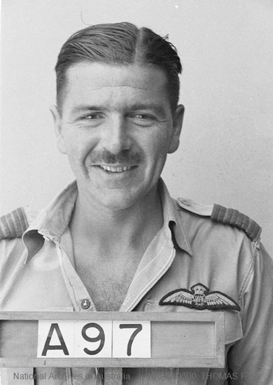
Commanding Officer Wing Commander Frederick William Thomas
(250097), was formed at Garbutt Airfield on the 23 February
1942 with a strength of:-
35 Officers
2 G.D.
1 Dental
3 Medical
5 Nursing
2 Equipment
4 C.W.O.
15 A.&S.D.
3 Chaplains
497 airmen (109
attached)
Motor Transport Vehicles were:-
16
Light Tenders
20 Heavy Tenders
1 Panel Van
1 Heavy Dropside
2 Tip Trucks
1 Staff Car
1 Fire Tender
4 Utilities
2 Ambulances (4
berth)
4 Tractors
4,251 messages received totalling 144,619 GroupsAn "Air Raid Alert" was issued in Townsville on 1 May 1942 at 0900 hours and the "All Clear" was given at 0930 hours. Signals personnel were dispersed and lived off Station. Work was underway on the duplication of the Signals Office but some delays had been caused by the shortage of lines available.
3,931 messages transmitted totalling 155,955 Groups
Groote Eylandt - 1 Light Tender, 1 Tractor and 2 Heavy TendersOn 5 May 1942, 2 Heavy Dropsides and 1 Tip Truck were received.
Horn Island - 3 Heavy Tenders, 1 Light Tender
4 Heavy Tenders2 Heavy Tenders were issued to North Eastern Area on 24 June 1942. RAAF Station Townsville took over fourteen 81mm mortars from the US Army along with ammunition on 25 June 1942.
1 Fire Tender
1 Ambulance (4 berth)
1 Light Tip Truck
6 Chevrolet Utilities
2,956 messages were received totalling 96,897 groupsThe monthly parade of Station personnel wearing gas respirators was held on the 1 July 1942.
2,934 messages were transmitted totalling 58,373 groups
3,975 messages were received, totalling 107,131 groups.In addition to these totals, the Meteorological transmission carried out from the Meteorological Office compiled the following traffic totals:-
2,484 messages were transmitted, totalling 54,911 groups.
Messages received 209, totalling 7,055 groups
Messages transmitted 1,140, totalling 66,303? groups
RAAF Station Garbutt
Headquarters RAAF Station Garbutt
5 Communication Unit
2 Air Ambulance Unit (Detachment)
13 A.R.D Forward Section (Detachment)
13 A.R.D. M.T.R.S. (Detachment)
13 A.R.D. Industrial Gas handling Section - Oxygen Section (Detachment)
The Commanding Officer was Wing Commander George Campbell Matthews A.F.C. (250195). The C.O. went on annual leave from 17 Dec 1944 to 2 Jan 1945 and Squadron Leader Basil Bannister Daish (260426) took over as the temporary Commanding Officer.
36 Squadron
RAAF was based on RAAF Station Garbutt as a lodger unit
during December 1944.
During December 1944, conditions on
the W/T circuits were fair to good. On the reconnaissance,
convoy and standby D/F watches, the day frequencies have been
good with slight atmospherics and interference. Night
frequencies are only fair, especially in the early mornings,
when atmospherics have been very bad. All aircraft on travel
flights have been provided with essential two way communications
and information on all signals facilities.
Traffic passed by RAAF Station
Garbutt to Townsville W/T, was all
by Teleprinter, with the exception of safe hand signals, or when
the Teleprinter circuit was unserviceable, and traffic was
passed by phone, or Tone line. The performance and condition of
the Radio Range equipment over December 1944 was satisfactory.
The equipment had been on the air continuously, except for a
period of five hours, which was the time taken for monthly
inspections and servicing.
No modifications were made to the H/F D/F station during
December 1944. Usual weekly ground calibrations were carried
out, and information was forwarded to Headquarters,
North Eastern Area.
A Transport pool consisting of all
motor transport on strength of units at Garbutt was formed on 15
December 1944 and placed under the control of RAAF Station
Garbutt. .
Aircraft Movements for
December 1944
| Arrivals
|
Departures |
|
| USAAF |
1462 |
1458 |
| RAAF |
352 |
344 |
| Civilian |
244 |
246 |
| Dutch (NEI-AF) |
24 |
24 |
Accommodation for all ranks was
acute, and officers were occupying Airmen's quarters. In order
that this could be overcome, eight small prefabricated huts were
erected and occupied by officers, and a further 24 small huts
were in the course of construction. Total personnel accommodated
permanently, as at 31 January 1945, was 103 officers, 618
airmen, 86 WAAAFs, for a total for a total of 807 personnel.
Accommodation for transient personnel was restricted to crews of
aircraft in transit only.
In January 1945, RAAF tactical and
transport aircraft were serviced by a duty crew under the direct
supervision of the Station Engineer Officer, who was also
Officer in Charge of No. 13 A.R.D. (13
Aircraft Repair Depot)
Forward Section. Refuelling of transient aircraft was the
responsibility of the USAAF during January 1945. Four RAAF
personnel were supplied permanently to assist the Americans in
refuelling operations. No RAAF refuelling equipment was
available, and the number of USAAF refuelling tankers had been
considerably reduced during January 1945. With the shortage of
equipment and personnel, delays were experienced at times by
transient aircraft.
Flying control was in the hands of
the USAAF, although three RAAF clerks were employed permanently
in the control tower for the purpose of logging aircraft
movements, and keeping Air Defence Headquarters advised of all
such movements.
With a view to conserving manpower,
a Central Clothing Store was formed at RAAF Station Garbutt, and
commenced to operate on the 8 January 1945. All units based at
Garbutt Airfield were supplied by the Central Clothing Store.
The advance party of 35 Squadron arrived early in February
1945, and moved into a campsite at the eastern end of No. 2
Runway, previously occupied by the Allied Works Council A.W.C.
The remainder of 35 Squadron arrived
later in the month. 35 Squadron
was not a lodger unit on RAAF Station Garbutt, but came under
RAAF Station Garbutt for operation and maintenance of aircraft,
pay, and accounting.
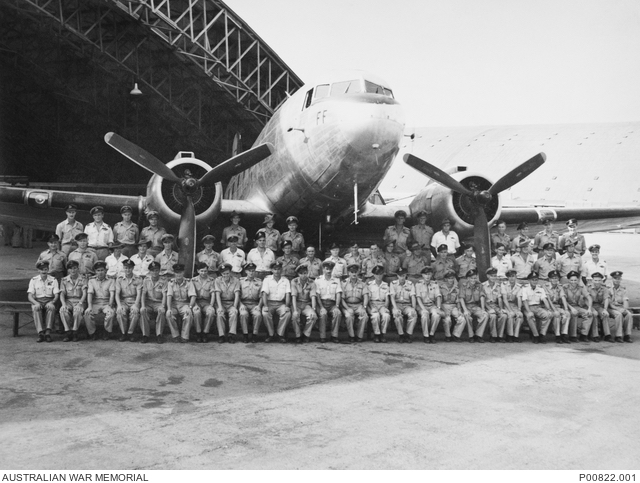
Royal Air Force C-47s passed through
Garbutt Airfield, on the 13
February 1945, for the first time, on a trip north for the
purpose of familiarisation and general reconnaissance. During
February 1945, several Royal Air Force aircraft remained
overnight at Garbutt Airfield.
There was a marked evidence of
decreasing activity in the main hangar. During February 1945
there were occasions on which no aircraft were receiving
maintenance in the main hangar, which was still occupied
exclusively by the USAAF.
During February 1945, a further
reduction of USAAF refuelling equipment and personnel was
experienced. The RAAF personnel supplied by RAAF Station
Garbutt, and units based at Garbutt
Airfield, were working solo satisfactorily. Some delays in
refuelling had been reported. RAAF Station Garbutt establishment
was amended during the month to provide for 10 refuelling
tankers, and two oil tankers.
During March 1945, a further
reduction of USAAF refuelling equipment and personnel was
experienced. Two 750 gallon refuelling tankers were received
against the establishment of RAAF Station Garbutt. These tankers
were being overhauled and were to be put into service during
April 1945. Complaints regarding delays and refuelling had been
received during the month, and all possible steps were being
taken to reduce delays to a minimum.
By mutual arrangement, a small
servicing party of Royal Air Force personnel arrived at Garbutt Airfield in March 1945 to
remain for the purpose of assisting the present RAAF Duty Crew.
During April 1945, two 750 gallon
RAAF refuelling tankers were put into service, and priority was
given to courier aircraft. No complaints were received,
regarding delays in refuelling. Cooperation with the USAAF was
excellent, and an improved service to transient aircraft was
anticipated. Due to the introduction of RAAF tankers, and due to
the appointment of one USAAF officer, exclusively for the
supervision of refuelling. In the past, the Officer-in-Charge of
refuelling, also had other duties, such as maintenance, and was
not located on the airfield, whereas he would now be situated in
the Base Operations Room.
Wing Commander Keith Ainsley
Hopkinson (260421), was appointed to temporarily command RAAF
Station Garbutt in the absence of Wing Commander George Campbell
Matthews, A.F.C. (250195).
A dust haze lasting for four days
occurred in the first half of April 1945.
Modifications were carried out to
the H/F D/F Station by
RAAF Headquarters Modification Party under Warrant Officer May.
That work was completed on the 15 April 1945. However, the H/F D/F Station was
unserviceable for approximately eight weeks due to the
installation of an earth mat.
No.
2 Air Ambulance Unit (Detachment), moved from the
transport hangar area to the main hangar on 30 April 1945. 75
foot of the main tarmac and stores, and office accommodation in
the main hangar, was being made available by arrangement with
the USAAF.
The H/F D/F station was still
unserviceable in May 1945, due to the installation of an earth
mat.
Seven refuelling tankers were in
service during June 1945 and operated satisfactorily.
During June 1945, 36 Squadron
Commanding Officer, and the Orderly Room vacated the
accommodation occupied at Station Headquarters, and moved to
their hangar area. Accounting Section vacated the area
underneath Station Sick Quarters and moved to Station
Headquarters. The accommodation vacated by the Accounting
Section was converted by unit labour into accommodation for
M.E.A.T.U. Sisters based at Garbutt. Additional accommodation
was erected in the S.S.Q. area by unit labour for the benefit of
the Sisters. Work commenced on the erection of a further
building adjacent to Block 64 for use by the Education Officer.
This work was carried out by unit labour.
During June 1945, the American Red
Cross Canteen for transients was taken over by the Australian
Comforts Fund A.C.F. on 30 June 1945. RAAF Station Garbutt
was required to supply transport to convey employees to and from
the Canteen, plus a driver for the mobile unit which operated on
the airfield throughout the night. The H/F D/F station was still
unserviceable due to the installation of an earth mat.
In June 1945, the Commanding Officer
reported that barrack's accommodation at Garbutt Airfield was superior to any
in the area, and the welfare of all ranks was well provided for.
The erection of a hut for the Education Officer, was in hand,
and should substantially improved general facilities for airmen.
Cook's Assistants were still in short supply, and messing
details continued during the month.
Orders for the move of 36 Squadron personnel from Garbutt to
No. 2 Project (USAAF Depot #2 near
Mount Louisa) were received during July 1945. The move was to be
affected by 1 August 1945. The move commenced with Sergeants and
Airmen moving from Blocks 59 and 108, and the Airman's compound
on 31 July 1945. The object of the move was to provide
accommodation at Garbutt Airfield
for RAF personnel and squadrons from the north, required to
carry out conversion from Kittyhawk to Mustang aircraft.
Authority from RAAF Headquarters
through 3D.W.O. was received to occupy A.T.C. building (I assume
this means Air Transport Command rather that Air Training Corps)
at Garbutt Airfield, that had
recently been vacated. The occupancy was to date from 1 August
1945. This was awaiting confirmation from N.E.A. headquarters.
The erection of a building for the
Education Officer, and an Airman's Recreation Hut, adjacent to
the Airman's Mess, were completed with Unit labour during July
1945.
The Transient Canteen under the
direction of the Australian
Comforts Fund (A.C.F.) operated satisfactorily during July
1945. Transport of personnel employed on the staff, plus
assistance of RAAF general hands continued to be the
responsibility of RAAF Station Garbutt. The mobile unit was also
manned each night by a D.M.T. of RAAF Station Garbutt pool.
The H/F D/F Station became
serviceable in July 1945 and operated continuously. Third class
bearings were only available, pending the completion of air
calibrations.
36 Squadron
Sergeants and other ranks vacated their living accommodation at
Garbutt Airfield on 1 August 1945,
and continued to mess at RAAF Station Garbutt until 26
August, when facilities were available in their own camp at No.
2 Project (Depot #2).
Officers of 36 Squadron were accommodated at Garbutt Airfield and fed at the
Station Mess throughout August 1945.
103 Royal Air Force personnel
arrived at Garbutt Airfield on 1
August 1945, and formed 193
Staging Post (RAF), under the command of Squadron Leader,
I.M.U. Galloway. 193
Staging Post functioned as an independent unit and was a
lodger unit on RAAF Station Garbutt. 193 Staging Post (RAF)
later moved to Camden in New South Wales on 1 March 1946.
The A.T.C. (Air Transport Command)
building was taken over by RAAF Station Garbutt, and was
occupied by No. 6 Transportation and
Movements Office 6 T.M.O., the Australian Red Cross, and
Customs and Commonwealth Security. The Station Commander was
responsible for the allocation of space in this building.
Authority was also received during the month to take over
portion of No. 2 Project (#2 Depot)
as a Transient Camp to be controlled by RAAF Station
Garbutt.
No. 2 Project (#2 Depot) was inspected by the
Station Commander, and Section No. 233 was selected for this
purpose. The policy regarding the provision of meals and
accommodation to transient personnel was clarified during the
August 1945, and the responsibility for the provision of both
meals and accommodation on a 24 hourly basis was placed on RAAF
Station Garbutt. Australian Red Cross undertook to provide meals
for all POWs. A new building was commenced at the rear of Sick
Quarters for the purpose of accommodating medical air evacuees.
P.M.O. North Eastern Area approved this building to be used for
medically unfit POWs.
The Butler hangar and adjacent
workshops were allocated for servicing transient RAF and RAAF
aircraft. This area was allotted only subject to cancellation of
the Mustang Conversion Course, which had not yet been definitely
notified.
The A.C.F. canteen (Australian
Comforts Fund) continued to operate during August 1945,
and no change was made in the assistance given by the Station.
Due to the move of 6T.M.O. Air Section to the A.T.C. (Air
Transport Command) building, a large proportion of the transient
personnel were being serviced by the mobile canteen, which was
parked in the A.T.C. (Air Transport Command) area constantly,
and was adequately catering for the present transient population
of all services. Third class bearings were still only available
from the H/F D/F Station,
pending the completion of air calibrations.
Hostilities in the Pacific finished
on 15 August 1945.
REFERENCES
RAAF Station Townsville Operations Record Book Apr 42 - Jul 42
23 Operational Base Unit Operations Record Book Jul 42 - Dec 44
RAAF Station Garbutt Operations Record Book Dec 44 - Feb 49
North
Eastern Area Headquarters Operations Record Book Jan 42 - Dec
45
Can anyone help me with more information?
"Australia @ War" WWII Research Products

|
|
© Peter Dunn 2015 |
Please
e-mail me |

This page first
produced 25 May 2026
This page last updated 28 May 2026