CHARLEVILLE AIRFIELD
CHARLEVILLE, QLD
IN AUSTRALIA DURING WWII
The following report is from the History of the Queensland Main Roads Commission 1939 - 1945:-
Charleville
The work of enlarging the previously existing civil aerodrome at Charleville began in December, 1941, and was finished in January, 1943. It consisted of clearing, grubbing, grading, gravelling, drainage and bitumen surfacing, the construction of taxiways and dispersal strips, besides excavations for large fuel tanks and the preparation of building sites. The first runway of 6,000 feet was completed to a stage suitable for aircraft landings within a week. Three gravelled runways in all were constructed and 88 acres of bitumen surfacing completed. Dust provided a nuisance and molasses spraying was tried with fair success. The maximum number of men employed was 335 and the approximate value of the work was £228,000.
The Queensland Main Roads Commission constructed an aircraft bore sighting range at Charleville Airfield.
Twenty five P-40 Warhawks of the 20th Pursuit Squadron (Provisional) USAAF escorted by B-24A Liberator #40-2374, left Brisbane on 29 January 1942 on their way to Darwin. One of the P-40s #89 flown by 2nd Lt. Bernard Oliver, cracked a wing on landing at Charleville Airfield on 29 January 1942. The aircraft was left behind in Charleville whilst the others flew on to Darwin.
The Douglas A-24 Banshees of the 27th Bomb Group passed through Charleville in February 1942 on their way to Darwin. One of their A-24s broke down at Charleville Airfield and the excited locals lined the airfield fence to look at the aircraft.
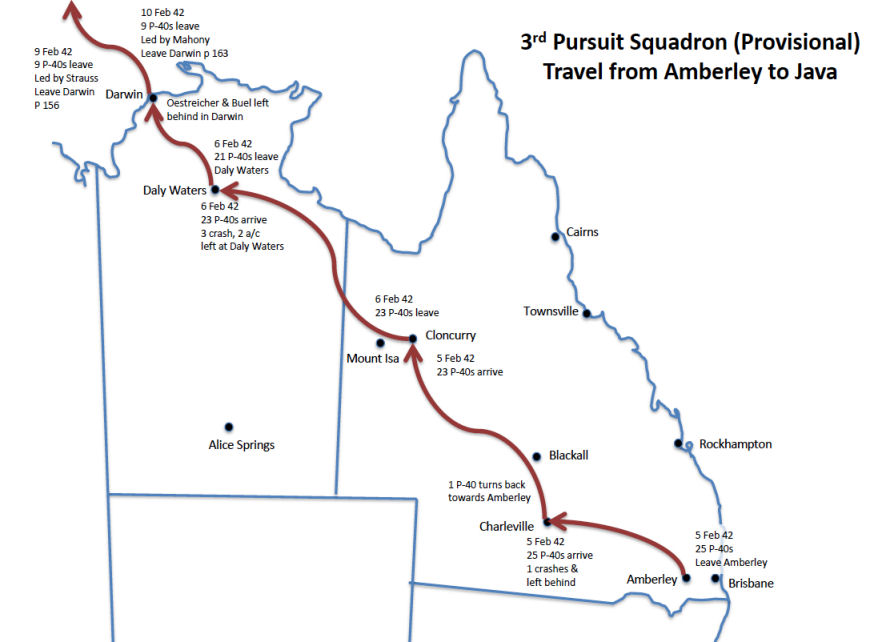
The 3rd Pursuit Squadron Provisional P-40 Warhawks travelled through Charleville on 5 February 1942
On 21 February 1942, the 8th Materiel Squadron at Amberley Airfield received new orders to move to a new station. The Squadron departed that same day for its new station at Charleville in western Queensland. The first echelon of 2 Officers and 50 Enlisted Men left Amberley Airfield by rail. The second echelon of 2 Officers and 44 Enlisted Men left Amberley at 1700 hours with the heavy convoy by road. The third echelon of 2 Officers and 49 Enlisted Men departed Amberley at 2200 hours with the light motor convoy by road. At the time of this move there were 5 Officers and 59 Enlisted Men on Detached Service.
The first echelon arrived at Charleville on 22 February 1942 and unloaded their equipment and set up a camp about one mile south east of the city near the Charleville Airfield. The third echelon with the Squadron's motor convoy was delayed at Dalby because of necessary bridge reinforcing and road repair.
The 8th Materiel Squadron was again ordered to return to Amberley Airfield as it permanent change of station. The third echelon of 1 Officer and 49 Enlisted Men departed by road with the light motor convoy on 27 February 1942 after receipt of their Movement Orders. The second echelon with the heavy motor convoy turned around at Dalby and the first echelon of 1 Officer and 50 Enlisted Men departed for Amberley by rail.
When the first echelon arrived at Dalby on 28 February 1942, they received new orders by telephone to return to Charleville for a permanent change of station!! So they returned to Charleville on the same day. The third echelon turned back at Roma and also arrived in Charleville on 28 February 1942. The second echelon with the heavy motor convoy turned back when it arrived in Toowoomba.
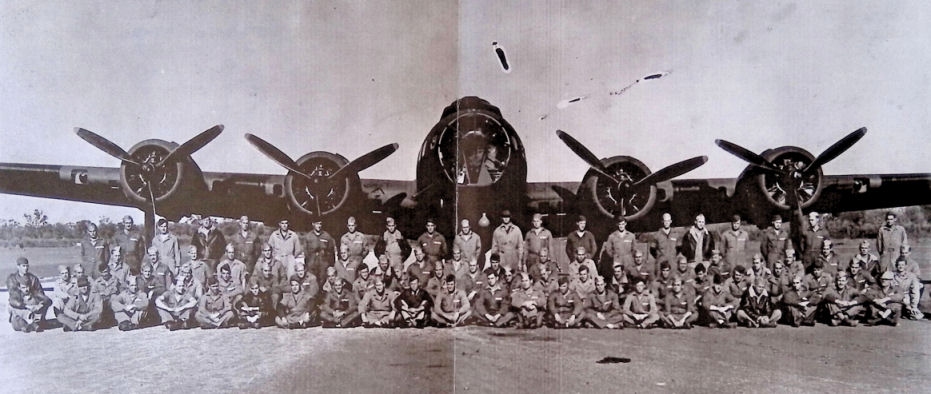
Photo:- via Alex Nott
A B-17 Flying Fortress and flight line personnel of the 8th Materiel Squadron at Charleville Airfield in 1942
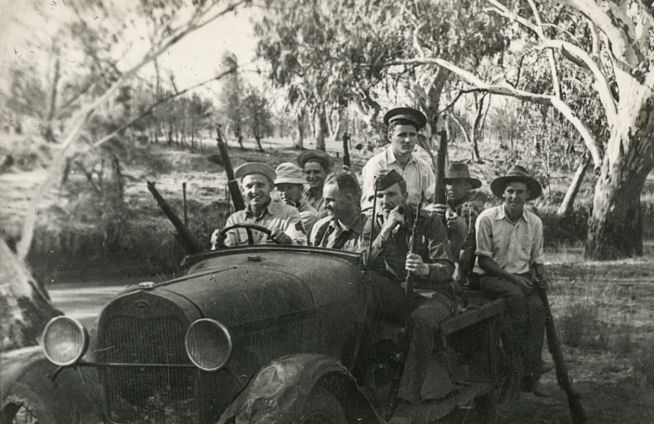
Photo:- via Alex Nott
Probably a "Roo Shooting Party" with some
locals taking the Yanks shooting Kangaroos
In 1942 Charleville Airfield became the Reception Depot for new USAAF aircraft arriving in Australia from the USA, where they were serviced, repaired and stored prior to being allocated to operational squadrons. The 45th Air Base Group and its attached units looked after this Reception Depot. Whilst control of the airfield was handed over to the United States Army Forces in Australia (USAFIA) on 10 July 1942, the 45th Air Base Group and some of its attached units were based at Charleville Airfield as early as 15 April 1942.
Five large hangars were erected at Charleville Airfield during WWII. Four hangars were 96 feet by 96 feet and the fifth and last one constructed, Hangar 101, was a very large 184 feet by 174 feet. The Qantas Ltd Hangar at Charleville Airfield was also used by the 45th Air Base Group.
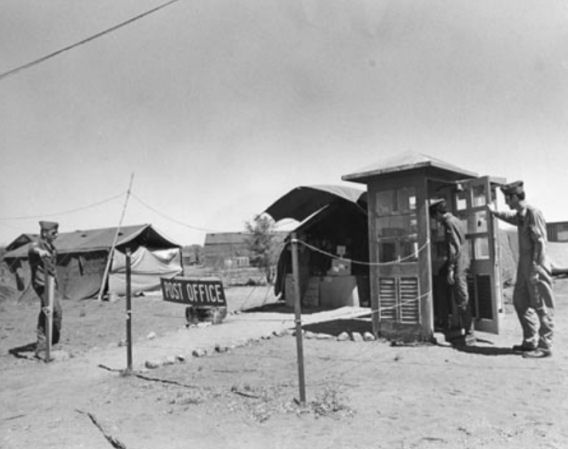
Photo:- via Alex Nott
American Post Office at Charleville Airfield during WWII
The book "The Battle of Brisbane" by Thompson and Macklin stated that "in a Tokyo studio, Iva D’Aquino, a.k.a. Tokyo Rose, was learning to pronounce Queensland names like Camooweal and Charleville for her propaganda broadcasts". Japanese spies in Australia ensured they knew where the new airfields were being located.
On 4 August 1942, Lieutenant Morris Friedman and his crew from the 93rd Bomb Squadron of the 19th Bomb Group were transferred to the 64th Bomb Squadron of the 43rd Bomb Group. They had orders to pick up a plane, "Chief Seattle", from the Charleville Depot and deliver it to their new squadron at Fenton, south of Darwin. They picked up the aircraft and flew first to Daly Waters, not being able to locate Fenton. After receiving directions, they continued the flight to Fenton the next day. The 64th Bomb Squadron was waiting for the first of their new B-17Fs from the United States. When "Chief Seattle" arrived, it became their first and only B-17, but just for a day. On 6 August 1942 they lost it when additional orders came through for the crew and plane to fly to Townsville for an assignment with the 435th Bomb Squadron of the 19th Bomb Group.
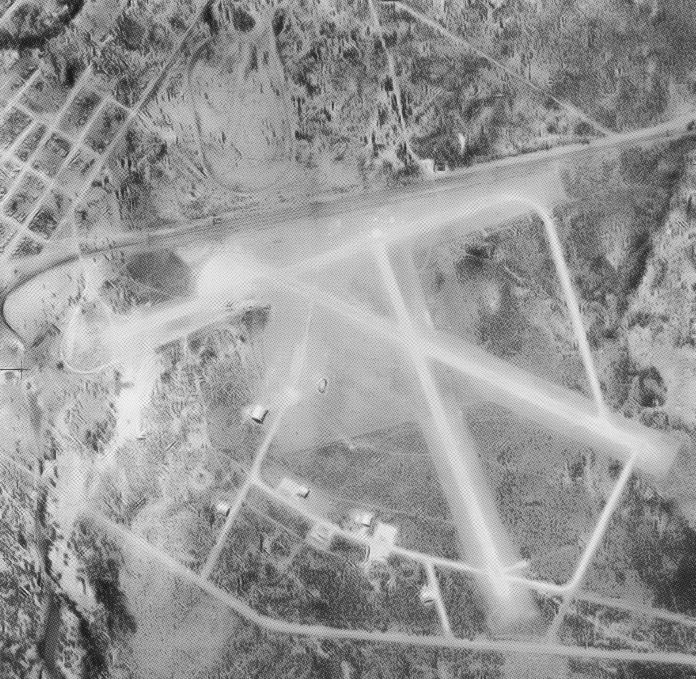
The five hangars can be seen in this 26 June 1943 aerial photo
The following entry is from the Heritage entry for Hangar 7 at Eagle Farm Airfield in Brisbane. Apparently the change from Eagle Farm to Charleville was because of the concern of a possible Japanese invasion:-
The construction of hangars 3, 4, 8 and 9, at Eagle Farm Airfield to an Australianised RAF Type A 1917 design, were begun by contractor T.H. Dennis, but in April 1942 construction work ceased and the hangars were relocated to Charleville. This situation changed quickly, and the hangars were relocated back to Eagle Farm from circa November 1942, to eventually double the length of Hangars 1 and 2 at Eagle Farm, and create hangars 3 and 3A (work was still being carried out in January 1944).
From National Archives of Australia:- BP1/1, Volume 2; page 10 of 515; AWCQ Meeting No. 73 held on 15th September 1942.
1324. CONSTRUCTION OF CONCRETE SLABS - CHARLEVILLE AERODROME:
Blank requisition was received from U.S. No. 3 Base Station for the construction of concrete slabs at Charleville Aerodrome. This was accompanied by a memorandum from the Construction Manager suggesting that a price be obtained from Mr. Dennis who is constructing hangars at the aerodrome. It was decided that a price should be secured from Mr. Dennis as suggested and Mr. Barker will arrange for finalisation of a contract if the price is suitable.
The 450th Service Squadron was activated at Charleville on 7 September 1942 with Major Jerry H. Dunkelberger its first Commanding Officer. Personnel from the 8th Service Squadron and Headquarters and Headquarters Squadron 45th Service Group transferred to the 450th Service Squadron. Strength on activation was 4 Officers, 1 Warrant Officer and 199 Enlisted Men. heir stay in Charleville was very short lived. A first echelon consisting of heavy motor vehicles departed Charleville for a new Station on 7 September 1942. A second echelon left Charleville at 6:00am on 9 September 1942. It comprised light motor vehicles. The third echelon left Charleville at 1:30pm on the same day.
Operational Training Group #1 was also based at Charleville Airfield where they trained bomber crews on how to use the Norden Bomb Sight. A special concrete building, which still exists today, was built to house and secure the Norden Bomb Sights.
On 29 July 1943, a Detachment of the 3rd Airdrome Squadron under Captain Mitchell was sent to Charleville from Eagle Farm Airfield where they were attached to the 81st Air Depot Group. They were sent to Charleville to dismantle a hangar. For the outstanding work done at Charleville, teh Detachment was commended by Colonel Minty.
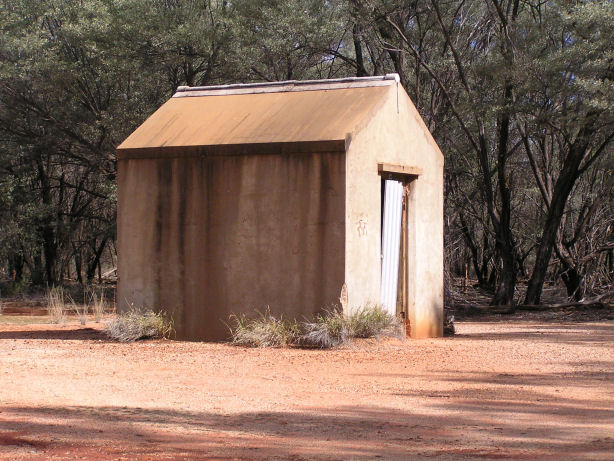
Photo:- Kristy Rowland
The concrete WWII Norden Bomb Sight building at Charleville Airfield
Brigadier-General Ralph Royce visited Charleville Airfield a couple of times as noted in his wartime diary as follows:-
5 May 1942
Gowan, Kurtz, Legge, Alley & I breakfasted at hotel – to Bankstown, off at 9:05 – Alley made
the trip and took many pictures – landed Charleville 12:30 (3 hrs. 25 mins.) – lunch at off. Mess
in new hospital – Lt. Col Cruse – to plane & off at 1:40 taking ten ferry pilots with us. Landed at
Laverton at 5:35 (4 hrs 55 mins) – to house taking Norman Alley with us – dinner & coon can.14 May 1942
Up early – mess – to field – off at 7:00 for Daly Waters 8:55 (1 hr. 55 mins.) talked to Lieut in
charge of detachment of base group – off at 9:10 for Cloncurry 12:10 (3 hrs.) lunch in mess – off
at 13:45 to Charleville 1700 (3 hrs. and 15 mins) – to mess with Lt. Col Cruse and then to
Charleville Hotel – bed early and then Northcutt came in and talked to me quite awhile6 June 1942
Up at 4:30 – picked up Bill Courtney and Sherrod at hotel and to Laverton – trouble starting
engines – to club – finally off at 12:45 and to Charleville – Bostock, Perrin, Van Atta, Courtney,
Sherrod & myself and crew of seven – Kurtz piloting – I landed ship. Col Cruse took us on tour
and to Charleville Hotel – Sherrod ill & to bed – dinner at Corones Hotel – bed early.
Plane loaded with magazines, games, candy, cigarettes, etc. for Moresby. 1 case of liquor for
Scanlon – minus 3 bottles for Sneed – also 3 cases of beer for Bladin.
12:40-16:50=4 hrs. 10 mins.2 July 1942
Breakfast at house – office – to field at twelve and off in B-17 for Charleville – to hotel – talked
business about an hour – cleaned up – to Corones Hotel for dinner & to bed early
Carmichael, Chaffin, Schriever, Nichols, McAdam, Schreiber and 4 mechs.
12:15-16:50=4 hrs. 35 mins.
By November 1942, Mr. L. S. Steine visited Charleville Airfield to prepare an estimate to paint the hangars. He noted that by that time there were only a small number of personnel on site mainly USAAF personnel. He saw four prefabricated workshop buildings, each 80 feet by 40 feet, being dismantled for relocation elsewhere. There were no aircraft and the airfield looked deserted. The Americans also dismantled another three prefabricated workshop buildings, each 80 feet by 40 feet at the Glenroy Wool Scour. An earlier request had been received by the Allied Works Council from Lieutenant Larson, USNR, for four of these buildings, two required urgently and the other two in the near future for barracks and stores buildings. Colonel M. C. Young, Air Corps, Chief of Staff advised that the request should not be favorably considered as the four structures were required for a forward base overseas and the other three were being used for storage but once the storage space was no longer required the buildings were required for another advanced base. Lieutenant Larson was advised that the four buildings were not available.
The Allied Works Council commenced erecting various camp areas at the airfield in readiness for the occupation of the airfield by 15 Operational Base Unit RAAF. On 25 January 1943, Mr. M. C. Cox, the Queensland Construction Manager for the Allied Works Council noted that a substantial number of buildings for Camps A, B and C were completed along with water services and sewerage for Camps A and B. The Parachute Drying Tower was finished and the sewerage pumps for Camp C, which served the Workshop Hangars 103, 104 and 105, were on site. Hangar 101 the largest hangar was mainly completed.
No 15 Operational Base Unit RAAF was formed at Charleville Airfield, on 4 March 1943 with 17 personnel under the command of Flight Lieutenant Victor John Bahr (272550). 15 OBU's primary role was to operate and make secure the Charleville airfield and the
RAAF Fuel Depot and Store at Glenroy Siding (Glenroy Scour Siding), Charleville.
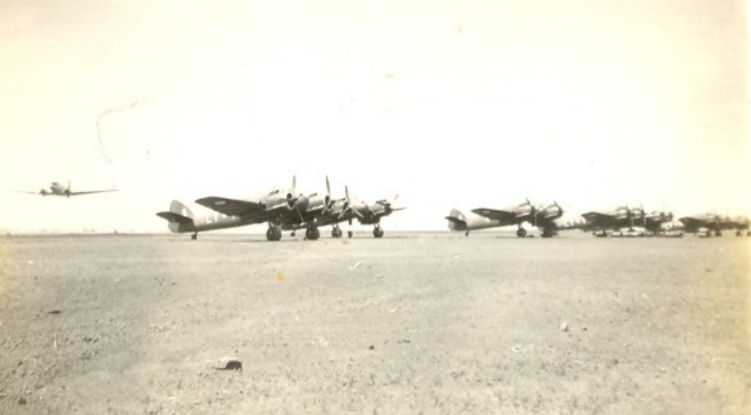
Photo:- via Alex Nott
Some RAAF Beaufighters at Charleville Airfield with a C-47 at the left
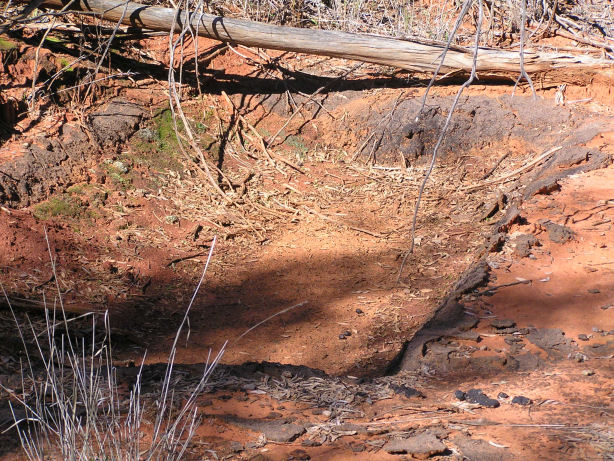
Photo:- Kristy Rowland
Remains of one of a number of
depressions dug in the ground at Charleville
Airfield,
probably storage trenches which would have been covered with corrugated iron.
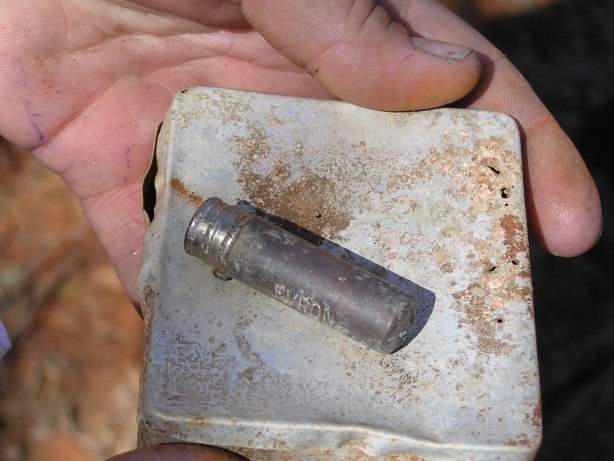
Photo:- Kristy Rowland
Items recovered from a WWII slit trench at Charleville Airfield
The Alphabetical List of Landing Grounds - Queensland shows the following entries for Charleville"-

Another Emergency Landing Ground ELG in the area was Bonnievilla Airfield.
Steve Meekin remembers the black drums that the bitumen came in (44 gallons size) were still around the airfield in the very early 1960s with a lot of them around town being used for other things such as squashed flat and used as bulkheads for road works. There were still some hangars at the airfield in the early 1960s that have now been demolished. Steve also remembers that around Charleville in those days there were quite a number of telephone poles made from pre-formed metal interlocking sections. His father told him that they were erected by the Americans.
Charleville Meatworks Airfield ELG
Flights by William R. Eaton of 19th
Bomb Group
through Charleville during WWII
Military Units at Charleville during WWII
REFERENCE BOOKS
"Queensland Airfields WW2 - 50 Years On"
by Roger Marks
"History of the Queensland Main Roads Commission 1939 - 1945"
"The Battle of Brisbane"
by Peter Thompson and Robert Macklin
ACKNOWLEDGEMENTS
I'd like to thank Steve Meekin and Allan Tonks for their assistance with this web page.
Can anyone help me with more information?
"Australia @ War" WWII Research Products

|
|
© Peter Dunn 2015 |
Please
e-mail me |

This page first produced 23 August 2019
This page last updated 20 February 2026